
explore
'What to actually wear on Malta''s trails: trail running shoes and gear for
Malta's polished limestone and loose rubble need sticky-rubber outsoles, 4–5mm lugs and a rock plate, plus 1.5–2L of water.
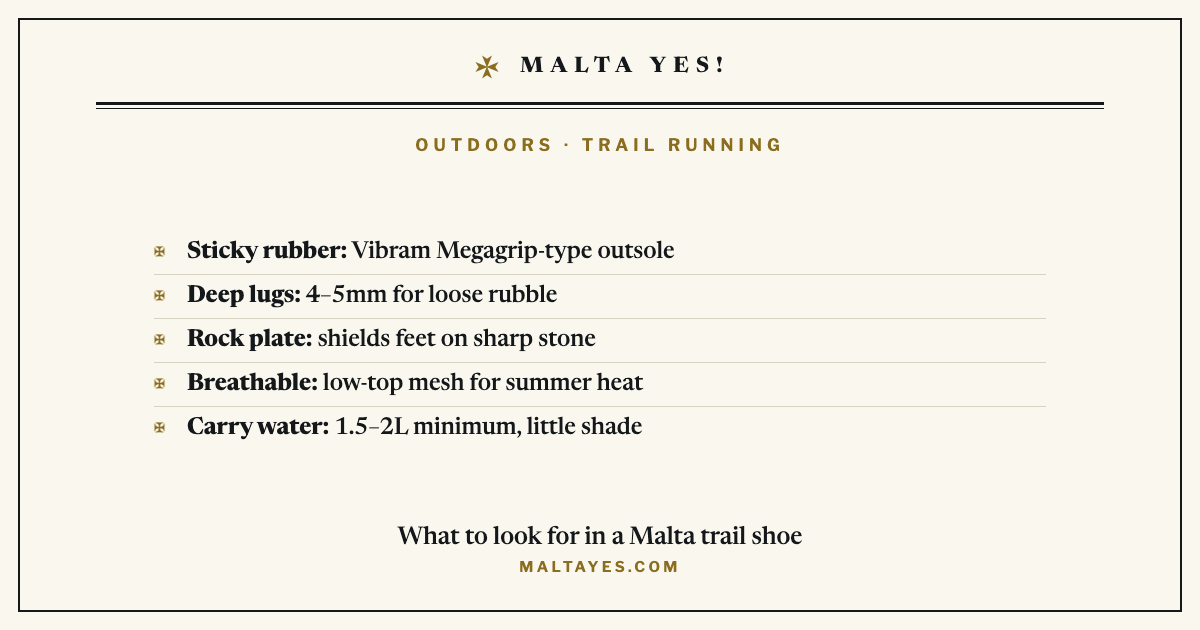
If you are buying trail shoes for Malta, the terrain should decide the shoe — and Malta’s terrain is not what most “best trail running shoes” lists assume. You will meet four surfaces on a single run: polished limestone that turns slick when damp, loose rubble that bruises the sole, packed dirt, and the odd stretch of sand. What that means in practice: prioritise a sticky-rubber outsole (a Vibram Megagrip-type compound), deep 4–5mm lugs for the loose sections, a rock plate to shield your feet on sharp stone, and a breathable low-top for the heat. And whatever you wear on your feet, carry 1.5–2L of water, because shade on Maltese trails is close to non-existent.
This is the gear companion to our guide on where to run and which races to plan a trip around. That piece covers the routes; this one covers what to wear on them — the question every generic shoe review skips, because none of them have run on Mediterranean limestone.
Key facts
- Four surfaces, one run. Polished limestone, loose rubble, packed dirt and occasional sand — Malta mixes all of them, often in a single outing.
- Sticky rubber matters most. A Vibram Megagrip-type outsole is the compound that recurs across 2026 rocky-terrain shoe reviews; smooth-soled trainers are not adequate here.
- Limestone is worst when wet. Malta’s polished limestone is low-friction when dry and near-frictionless when damp — the opposite of the grippy granite most reviews assume.
- Lugs and a rock plate for the rubble. Deep 4–5mm lugs bite into loose stone, and a rock plate shields the sole from bruising on sharp rubble.
- Carry 1.5–2L of water. For a half-day or short route in season; more for longer efforts. Shade is scarce, so plan hydration harder than on forest trails.
- Heat drives everything in summer. June to September runs 30–35°C with little shade, so early-morning starts (06:00–08:00) and ventilation come first. [VERIFY]
Why Malta’s terrain is different
Most trail-shoe advice is written for forest, alpine or Pacific-Northwest trails — soft ground, grippy granite, tree cover. Malta is none of that. The defining surface is limestone, and Maltese limestone behaves in a way that catches out runners used to mountain rock. When dry it is merely low-friction; when damp — after rain, or on a shaded slab that has not dried out — it becomes genuinely slippery, close to frictionless. That single property should shape your shoe choice more than anything else.
Then there is the rubble: loose, broken stone on many inland and cliff-edge paths, sharp enough to bruise the sole of an under-protected shoe and unstable enough to roll a foot. Add stretches of packed dirt (the easy bits) and the occasional band of sand near the bays, and you have four different demands on one run. No single “best trail shoe” nails all four, so you choose for the surface you will spend the most time on — and in Malta, that is usually limestone and rubble.
What to look for in a shoe
Four features matter here, in roughly this order.
Sticky rubber outsole. This is the one that counts most on limestone. Look for a high-friction rubber compound — Vibram Megagrip is the name that recurs across current rocky-terrain reviews, and La Sportiva’s FriXion is a comparable in-house compound. Some 2026 models are now even marketed with a measured wet-rock friction figure, which is exactly the property Malta’s damp limestone punishes. Do not buy a smooth or road-oriented outsole for these trails.
Lug depth for the rubble. For loose and technical ground, deep, aggressive lugs — around 4–5mm, in a chevron or butterfly pattern — bite in and hold. Shallower lugs are fine for packed dirt but wash out on Malta’s loose sections. If you run mostly the rubble and cliff paths, err deeper.
A rock plate. This is the piece Malta-specific advice never mentions and rubble runners feel the lack of. A rock plate is a thin protective layer in the midsole that stops sharp stones bruising your foot. On Malta’s rubble it earns its keep, and in current shoe designs it adds very little weight.
Breathability for the heat. For most of the Maltese year you want a breathable low-top with a mesh upper that drains and ventilates. Waterproof (Gore-Tex-type) uppers trap heat and are the wrong call for a hot, dry, sun-exposed climate — save any mid-ankle or more enclosed shoe for the cooler, wetter winter months or longer mountain trips elsewhere.
Shoe picks, and how to read them
A caveat first: no published review tests shoes on Maltese limestone specifically, so treat named models as examples of the right compound category, not as Malta-verified picks. With that said, the shoes that 2026 rocky-terrain reviews rate highly are a sensible shortlist because they carry exactly the outsole tech that suits Malta. The La Sportiva Prodigio Pro uses FriXion rubber; the Merrell Agility Peak 6 runs a Megagrip outsole and has been measured at a 0.64 friction coefficient on wet rock — a directly relevant number for damp Maltese limestone; and the Norda 055 uses Megagrip Elite. The point is not to buy one specific shoe, but to buy for the compound: if a shoe you already like comes in a Megagrip or FriXion outsole with 4–5mm lugs and a rock plate, it will serve you well here. On sizing, trail shoes often fit differently from road shoes and from Japanese sizing conventions, so try before you buy where you can, or check where to rent or buy trail gear once you are in Malta.
Non-shoe essentials
Shoes are the terrain-specific part, but two other things are non-negotiable on Maltese trails.
Water — 1.5–2L minimum. For a half-day or short route in season, carry at least 1.5–2L per person, and scale up for anything longer. This matters more in Malta than on a typical forest trail because there is almost no shade and, on most routes, no tap to refill from. Plan your water as if there will be none on the way — because there usually is not. A vest or belt that carries soft flasks or a bladder is worth having.
Sun protection. With the trail network largely treeless, sun is a constant, not an occasional factor. A cap or visor, sunglasses and sunscreen are baseline, and light, ventilated clothing beats bare skin in the midday sun.
Gaiters, if you run the rubble. Low trail gaiters keep grit and small stones out of the shoe on the loose sections and sandy stretches — a small comfort item that prevents the stop-and-empty-your-shoe routine.
Route by terrain: match the shoe to the run
Malta’s routes are not uniform, so it helps to know which demand you are buying for.
Coastal and exposed — the runs around Xemxija, St Paul’s Bay, Qawra and Salina Bay are mixed promenade, pavement and coast road, up to about 12km. The rock hazard is lower here, but you are fully sun-exposed, so ventilation and water lead over aggressive grip. The first-person Xemxija to Għajn Tuffieħa coastal run is the reference route for this type.
Sand in the mix — the Golden Bay to Għajn Tuffieħa stretch alternates sandy trail and paved sections, and sand adds its own demand: a shoe that drains and sheds grit rather than holding it. Our Majjistral and Golden Bay walk guide covers this ground.
Limestone-technical and rubble — the inland and cliff routes, including the Victoria Lines, are where sticky rubber, deep lugs and a rock plate all earn their place. If you mainly run these, buy grip-first. The Dingli Cliffs and Victoria Lines walk shows the kind of terrain involved.
Seasonal adjustment
The right shoe shifts a little with the season. In summer (roughly May to September), ventilation and heat management come first: breathable low-tops, early starts between 06:00 and 08:00 before the 30–35°C peak, and water as the priority. In the wetter winter months (roughly November to February), grip becomes the headline concern, because that is when the limestone is damp and at its most treacherous — this is when a top-tier sticky-rubber outsole with a proven wet-rock rating really pays off. If you own one pair, prioritise the wet-rock grip: it is safer to be slightly over-shod for summer heat than under-gripped on wet limestone in January.
Frequently asked questions
Are trail running shoes good for rocky terrain?
Yes — provided the outsole uses a sticky rubber compound (a Vibram Megagrip-type) and has enough lug depth for the loose sections. Smooth-soled or road-oriented running shoes are not adequate on Malta's rock, especially when the limestone is damp. For Malta specifically, look for a high-friction compound, 4–5mm lugs for the rubble, and ideally a rock plate for underfoot protection. Buy for the surface you will spend the most time on, which here is usually a mix of polished limestone and loose rubble.
Do I need a rock plate for trail running?
For Malta's rubble sections, it is well worth having. A rock plate is a thin protective layer in the midsole that stops sharp or loose stones bruising your foot, and Malta's broken-stone paths are exactly the terrain it is designed for. In current 2026 shoe designs it adds very little weight, so there is little downside. If you only ever run packed coastal promenade, you can manage without one, but for inland and cliff-edge rubble it noticeably improves comfort and protection over a long run.
What shoes are best for wet, slippery rock?
Shoes with a high-friction rubber compound and, ideally, a tested wet-rock grip rating — some 2026 models are now marketed with a measured friction coefficient for exactly this reason. This matters in Malta because its polished limestone is at its most hazardous when damp, not dry: after rain or on a shaded slab it can become close to frictionless. Prioritise the outsole compound over cushioning or weight if wet-season running is your plan, and be cautious on any smooth limestone that has not dried out.
How much water should I carry trail running in Malta's heat?
Carry a minimum of 1.5–2L for a half-day or short route in season, and more for longer efforts. Shade is scarce on most Maltese trails and there are rarely taps to refill from, so plan your hydration as if there will be none available en route. In summer, when temperatures reach 30–35°C, start early (06:00–08:00) to avoid the worst heat and drink before you feel thirsty. A hydration vest or belt with soft flasks or a bladder makes carrying that volume comfortable. [VERIFY] ---