
learn
How many weeks of English school in Malta do you actually need?
One English level takes about 200 guided hours — so 9–13 weeks in Malta, not 3 or 6. Match the weeks you study to your goal, not the school's booking.
There is no single right number of weeks. The honest answer depends on what you want from the course. For a real, certificate-level jump in your English, expect 9 to 13 weeks; for a confidence boost with a holiday attached, 1 to 3 weeks is plenty. This guide shows how those numbers are worked out, so you can choose for yourself — instead of trusting a school’s booking advice, which always has a commercial reason to be longer.
Key facts
- One CEFR level takes roughly 200 guided learning hours. (The CEFR is the standard European scale of English, from A1 to C2. “Guided” hours are hours taught by a teacher.)
- The hours add up from zero: about 180–200 to reach A2, 350–400 for B1, 500–600 for B2, 700–800 for C1, and 1,000–1,200 for C2 — so each new level costs more than the last. (Cambridge English)
- Malta has two standard course sizes: General English (20 lessons = 15 hours a week) and Intensive (30 lessons = 22.5 hours a week). One “lesson” is 45 minutes.
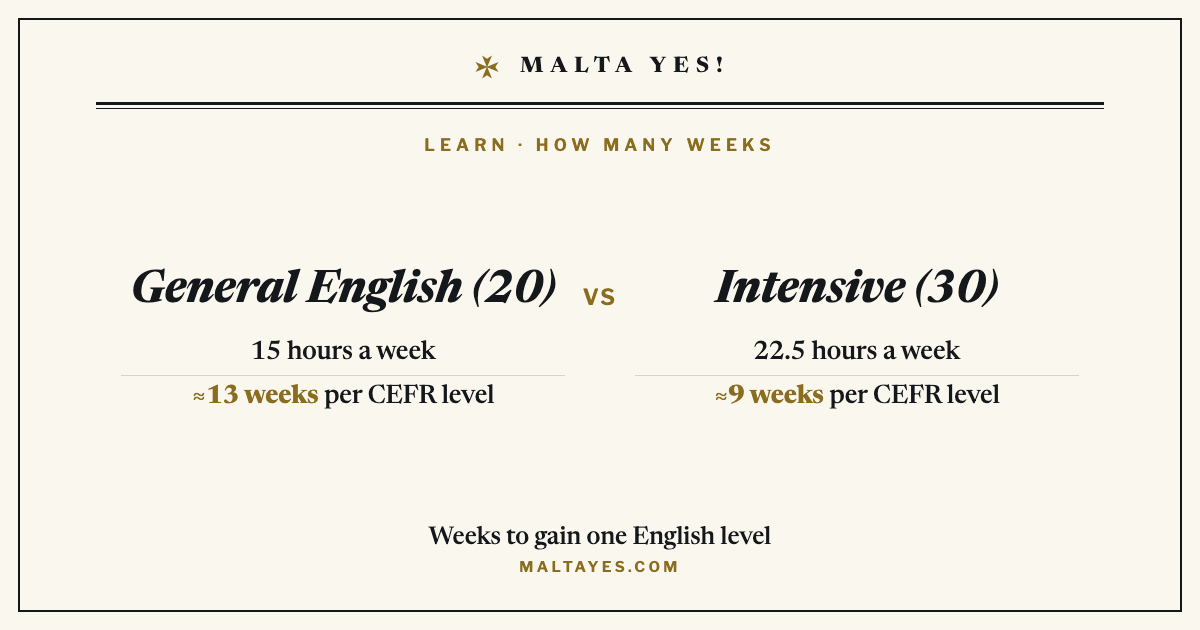
- So one level takes about 13 weeks at 15 hours a week, or about 9 weeks at 22.5 hours.
- Schools quote far less: Inlingua suggests “about 3 weeks to gain confidence”; EF advertises “a new level every 6 weeks”. Neither shows any working. [VERIFY: EF’s method is unpublished — treat as a marketing claim.]
- The price per week falls the longer you book (about €220–270 under 8 weeks, €180–225 over 21 weeks) — a built-in nudge to stay longer.
- Public holidays are not made up — lost lessons hit a one- or two-week booking hardest.
Figures current to 2026; Malta schools republish their price lists each winter.
The honest answer: it depends on your goal
Every school’s website names a different “ideal” length, and they rarely agree. That is not because the question is impossible to answer — it is because each answer is a sales figure, not a study figure. A longer booking is more revenue, so the recommended length quietly drifts upward.
Cut through it by asking a different question: what do I actually want to walk away with? A little more ease ordering coffee and chatting in class is a very different target from a certificate that says your level rose from B1 to B2. The first takes days. The second takes months. Once you know which one you are buying, the number of weeks almost chooses itself.
What actually moves you up a level
Here is the figure the marketing pages leave out. Cambridge English — the exam board most Malta schools prepare students for — publishes roughly how much teaching it takes to climb the CEFR ladder (the standard A1-to-C2 scale of English). As a rule of thumb, one full level is about 200 guided learning hours — hours taught by a teacher.
The totals are cumulative, counted from a complete beginner: around 180–200 hours to reach A2, 350–400 for B1, 500–600 for B2, 700–800 for C1, and 1,000–1,200 for C2. Two things follow. First, the higher you already are, the more hours your next level will cost. Second — and this is the part no booking page states — a level is a matter of hundreds of hours, not a fortnight.
Malta’s real numbers, turned into weeks
Malta keeps this simple. Almost every school offers the same two course sizes, and a “lesson” is 45 minutes at nearly all of them:
- General English — 20 lessons a week = 15 hours.
- Intensive — 30 lessons a week = 22.5 hours.
Divide 200 hours by each, and you get the honest range no school advertises:
| Your course | Hours a week | Weeks for one level (≈200 hours) |
|---|---|---|
| General English (20 lessons) | 15 | about 13 weeks |
| Intensive (30 lessons) | 22.5 | about 9 weeks |
So a visible level jump is a 9-to-13-week project, depending on how hard you push. How intensive to make your week is a separate decision with its own trade-offs — we work through it in how many lessons a week you actually need. And if you are weighing several months, look at the discounted long-term “academic year” courses before you commit week by week.
One quiet consequence of the 9–13 week range: thirteen weeks is 91 days — past the three-month mark that, for some nationalities, brings visa rules into play. If you are not an EU citizen and you are aiming for a full level, check whether you need a visa at all and, for longer courses, the long-stay study visa before you book.
Three goals, three very different answers
Holiday refresh (1–3 weeks). You will not change level in this time, and that is fine — it is not the point. A week or two knocks the rust off, rebuilds speaking confidence and gives you a daily routine of English. Inlingua’s own “about 3 weeks to gain confidence” is fair advice for this goal — just note that it is about confidence, not a level on paper.
A visible level jump (9–13 weeks). If you need a certificate to show a university or an employer that you have genuinely moved up, this is the real cost in time, straight from the hours maths above. Intensive gets you there in about 9 weeks; General English in about 13.
Exam-ready (it depends where you start). If you already sit near the target level, a few focused weeks of exam technique may be enough. If you need to climb a level first, add the 9–13 weeks before the exam polish. Timing matters too, because price and class make-up swing through the year — see the best time of year to study.
Why the school pages disagree — with each other and with the maths
Put the claims side by side and the gaps are obvious. Inlingua recommends “about 3 weeks to gain confidence” — on a page that has not changed since 2018, with no level-gain claim attached to it at all. EF goes further and advertises “a new level every 6 weeks” with full attendance, but publishes no method to back it up. Six weeks per level sits well below Cambridge’s own 9-to-13-week range once you do the arithmetic. [VERIFY: EF’s underlying method is not published; treat “every 6 weeks” as marketing, not a benchmark.]
Do not expect the regulator to settle it either. Malta’s language schools are licensed and regulated by the ELT Council under Legal Notice 221 of 2015, which is reassuring for teaching standards and student welfare — but licensing does not referee how many weeks buy a level. That question is left entirely to the marketing pages.
The catches that quietly eat your weeks
The pricing bands pull you longer. Malta schools charge less per week the longer you stay — very roughly €220–270 a week under 8 weeks, falling to €180–225 a week beyond 21 weeks. On a long, goal-driven stay that can be genuine value. It is also a direct commercial reason for a school to suggest “just a bit longer”, whatever your actual goal. Let the hours decide the length; let the bands decide only whether a longer stay is worth it once you already need one.
Public holidays vanish from short bookings. When a Maltese public holiday falls on a weekday, that day’s lessons are cancelled — and they are not rescheduled or refunded. On a 12-week course this is a rounding error. On a one- or two-week booking, a single holiday can quietly remove a tenth or more of the hours you paid for, so check the calendar before you fix your dates.
Frequently asked questions
Is two weeks of English course in Malta enough to notice a difference?
Yes — for confidence and comfort. Two weeks of daily lessons, plus a country where English is all around you, is enough to loosen up your speaking and rebuild fluency you had let slip. What it will not do is move you up a measured CEFR level: that takes roughly 200 hours of teaching, far more than two weeks can hold. Treat a short course as a refresh, not a level change.
How many weeks does it take to go up one English level?
About 9 to 13 weeks at Malta's standard course intensities. The maths is simple: Cambridge English puts one CEFR level at roughly 200 guided hours; a General English course delivers 15 hours a week (about 13 weeks) and an Intensive course 22.5 hours a week (about 9 weeks). Higher levels take longer, because each step up the scale needs more hours than the one below it.
Should I take a General or Intensive course if I only have a few weeks?
If your stay is short and you are chasing confidence rather than a certificate, the extra lessons matter less than you would think — Malta gives you free speaking practice the moment you leave the classroom. If you are racing a deadline, the intensive course packs the hours in faster. It is a real trade-off, and we work through it in [how many lessons a week you actually need](/learn/lessons-per-week-intensity/).
Do Malta's public holidays extend my course?
No. If a public holiday lands on one of your class days, that lesson is cancelled and not made up, so a holiday-heavy fortnight delivers fewer real hours than the calendar promises. It barely dents a long course, but on a one- or two-week booking it can remove a noticeable slice of your paid hours. Check Malta's public-holiday dates against your travel dates before booking. ---