
live
'Basing yourself in Gozo instead of Malta for a long stay: the ferry math and
Gozo runs 10–25% cheaper than Malta and the resident ferry fare is €1.15, not €4.65. But 94.9% of jobs sit on the main island. See who a Gozo base suits.
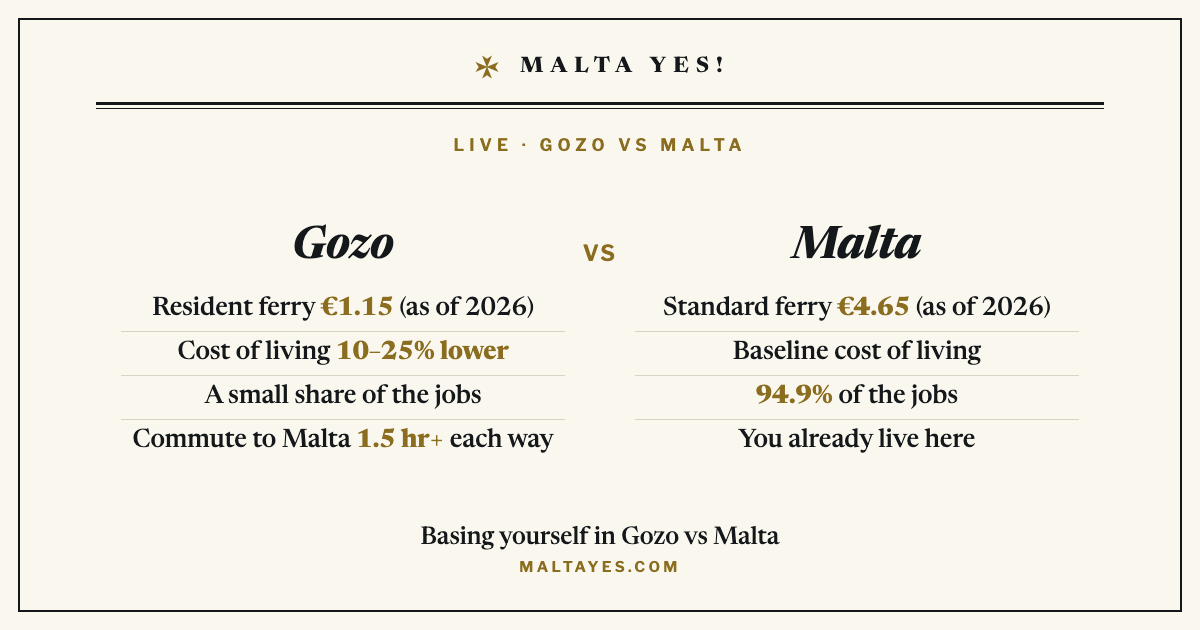
If you are choosing where to base yourself for a long stay in Malta, Gozo is the cheaper, quieter answer: living costs run roughly 10–25% below the mainland, and once you register as a resident the foot-passenger ferry fare falls from €4.65 to just €1.15 for the return trip. The catch is the commute. Almost 95% of Malta’s jobs sit on the main island, and the door-to-door trip from Gozo to central Malta commonly takes an hour and a half or more each way, even though the crossing itself is short. So Gozo suits a remote worker very well, and anyone who must be on Malta most days rather badly. Here is the ferry maths, the cost gap, and who each island fits.
Key facts
- The resident ferry fare is the headline saving. A standard adult foot passenger pays €4.65 for the return trip, charged once on the way back from Gozo; a registered Gozo resident pays €1.15 — a 75% cut. Car-and-driver drops from €15.70 to €8.15 (both as of 2026). You must show a valid Identity Card proving Gozo residency.
- The crossing is short; the commute is not. The car ferry takes about 25 minutes (Ċirkewwa–Mġarr), the fast ferry about 45 (Valletta–Mġarr), but door-to-door to central Malta commonly runs 1.5 hours or more each way.
- Gozo is cheaper, mostly on rent. Overall cost of living is about 10–25% lower; rent is the biggest gap, often 30–50% cheaper. Groceries and dining sit close to the mainland.
- The jobs are on Malta. NSO Malta data puts 94.9% of employment (by place of work) in the Malta region; only about one in five employed Gozo residents commutes across.
- It is really a remote worker’s decision. Malta’s Nomad Residence Permit has no island restriction, so a location-independent worker can base on Gozo with no commute cost at all.
Gozo or Malta in short
The whole decision is one trade-off. Gozo gives you lower costs, more space and a slower pace; Malta gives you the jobs, the fast links and shorter distances. If your income does not depend on being somewhere specific each day, Gozo’s savings are money kept. If work, a course or daily errands keep pulling you to the mainland, that distance becomes a daily tax on your time. Still deciding how much Gozo you want? Our guide to a Gozo day trip versus an overnight stay is a gentler test than a year’s lease.
The ferry maths: a short crossing, a long commute
The crossing is genuinely quick: the Gozo Channel car ferry between Ċirkewwa and Mġarr takes about 25 minutes, and the Valletta–Mġarr fast ferry about 45. The time goes on everything either side of the boat. To reach central Malta you travel to the northern terminal at Ċirkewwa, cross, then carry on to your destination. Residents and local guides put the real door-to-door time at 1.5 to 2 hours each way by car, and up to around three hours by public transport. As one Gozo guide fairly notes, commuting by boat “can take a lot of time, more than commuting in some capitals like London or Paris.” We set out the timetables, terminals and fare types in full in our guide to the Gozo ferry.
The fare is where a long stay saves real money, but only after you register. A standard adult foot passenger pays €4.65 for the return trip, while a registered Gozo resident pays €1.15; car-and-driver drops from €15.70 to €8.15 (all as of 2026). That resident rate is not given on request: you must present a valid Identity Card showing Gozo permanent-resident status. What no official source spells out is how quickly a new arrival — including a Nomad Permit holder who has just signed a Gozo lease — can register for that Gozo-address card and start paying €1.15 rather than €4.65. Until the card is in hand, budget for the standard fare.
What is actually cheaper in Gozo
Gozo’s saving is real but uneven. Overall cost of living runs roughly 10–25% below the mainland, and almost all of that gap is rent: a studio or one-bedroom flat is commonly €450–700 a month, and several sources put the rent gap at 30–50% cheaper than comparable mainland areas. Groceries, dining out and utilities, by contrast, sit close to Malta’s prices, since the same suppliers serve both islands. A single person can live comfortably on roughly €1,000–1,300 a month.
| Dimension | Gozo | Malta (mainland) |
|---|---|---|
| Resident ferry fare (foot) | €1.15 return | you live there |
| Standard ferry fare (foot) | €4.65 return | n/a |
| Cost of living | ~10–25% cheaper | baseline |
| Rent (studio/1-bed) | €450–700, 30–50% cheaper | higher |
| Share of Malta’s jobs | small | ~94.9% |
| Commute to central Malta | 1.5 hours+ each way | short |
One timing note: the gap narrows in summer, when short-let premiums hit Gozo’s tourist villages, such as Marsalforn and Xlendi, from June to September. The “cheaper” case is strongest for a shoulder-season or winter-based stay, and for a village away from the resort strip. (All fares and rents here are as of 2026 and can change.)
Jobs: why this is really a remote worker’s decision
The hardest number in the decision is employment. NSO Malta’s labour-market data puts 94.9% of employment, by place of work, in the Malta region — almost every job is on the main island. Only about one in five employed Gozo residents commutes to Malta for work, roughly 4,935 people in 2024, and they pay for it in ferry hours. If your livelihood means being physically on Malta, Gozo turns an ordinary commute into a daily 1.5-to-2-hour each-way journey, plus the fare and timetable. That is what the cheaper rent must be weighed against.
For a remote or location-independent worker, none of that applies. Fibre broadband is widely available across Gozo’s villages, typically 300Mbps to 1Gbps — plenty for video calls and remote work. The main gap is dedicated coworking, of which Gozo has only a handful of options, mostly around the capital, Victoria; most remote workers simply work from their accommodation. If you are setting up a longer stay, our guide to sorting internet and a long-stay set-up covers the connectivity side.
Who a Gozo base actually suits
Gozo suits the person whose work travels with them, and frustrates the person whose work does not. The clearest fit is a remote worker on Malta’s Nomad Residence Permit, which carries no island restriction — holders may live anywhere in the Maltese Islands, Gozo included — so you get the lower rent and calmer pace with none of the commute penalty. It has its own conditions, including a mandatory 12-month lease, a forward income requirement and health cover of €100,000; we set out the mechanics in our guide to the Malta Nomad Residence Permit, the piece to read before committing to a Gozo lease.
In short, Gozo fits you if you work remotely, value quiet over nightlife, and rarely need to be on Malta. It does not fit an on-site job, a course with daily mainland classes, or anyone who likes being ten minutes from everything. EU citizens, who move freely and face no visa question, sometimes weigh a Gozo base against a quiet Sicilian town instead — and Gozo connects onward, as our Sicily day-trip guide shows.
Which village, if you choose Gozo
Where you live on Gozo changes the commute more than any other choice. If you will cross to Malta often, base yourself near the Mġarr terminal in the south-east: Nadur sits about five minutes by car from it and is the practical commuter’s village, where places further west add time to every crossing. If you work remotely and rarely cross, the sums flip — Victoria, the central capital, puts you near the island’s services and coworking, while the coastal villages trade convenience for sea views and summer crowds.
One practical point: distances are small but buses are limited, so most long-stay residents find a car makes Gozo far easier, especially for the terminal run — we weigh up whether you actually need a car separately. Choose your village around your ferry habit, not the view, and Gozo’s trade-off tips in your favour.
Frequently asked questions
Is it cheaper to live in Gozo than Malta?
Yes, by roughly 10–25% overall, but the saving is almost all rent, which runs about 30–50% cheaper than the mainland — a studio or one-bedroom flat is commonly €450–700 a month. Groceries, dining and utilities cost much the same as on Malta. A single person can live comfortably on around €1,000–1,300 a month, though the gap narrows in summer when tourist-village rents rise.
How long is the commute from Gozo to Malta for work?
The ferry crossing is short, about 25 minutes by car ferry or 45 by fast ferry, but the door-to-door journey to central Malta is the real figure: commonly 1.5 to 2 hours each way by car, or up to around three hours by public transport. That is why commuting daily from Gozo is hard, and why a Gozo base makes far more sense for someone who rarely needs to be on the main island.
Can I use Malta's Nomad Residence Permit to live in Gozo?
Yes. The Nomad Residence Permit carries no island restriction, so holders may live anywhere in the Maltese Islands, Gozo included — which makes it a strong fit, with the lower cost of living and no commuting penalty. The permit's own conditions still apply, including a mandatory 12-month lease, a forward income requirement and health insurance of €100,000, which our dedicated permit guide sets out in full.
Do you need a car to live in Gozo?
Most long-stay residents find a car makes Gozo much easier. Distances are short, but buses are limited compared with Malta, and the run to the Mġarr terminal is far quicker by car if you cross often. If you live near the terminal in Nadur, you can manage without one, but for most people a car turns Gozo's spread-out villages into an easy fifteen-minute island.
When does the €1.15 resident ferry fare start?
The resident fare (€1.15 return, versus €4.65 standard, as of 2026) only applies once you hold an Identity Card showing Gozo permanent-resident status, so it rewards a real long stay. For a multi-month base it is a large saving, especially if you cross often. We could not confirm how quickly a new arrival can register for that card, so budget for the standard fare during any initial wait. ---