
live
Spotting a fake long-let listing in Malta before you wire a deposit
Malta rental scams share a pattern: stolen photos, a suspiciously low price, and pressure to pay before viewing. Plus the one real legal protection.
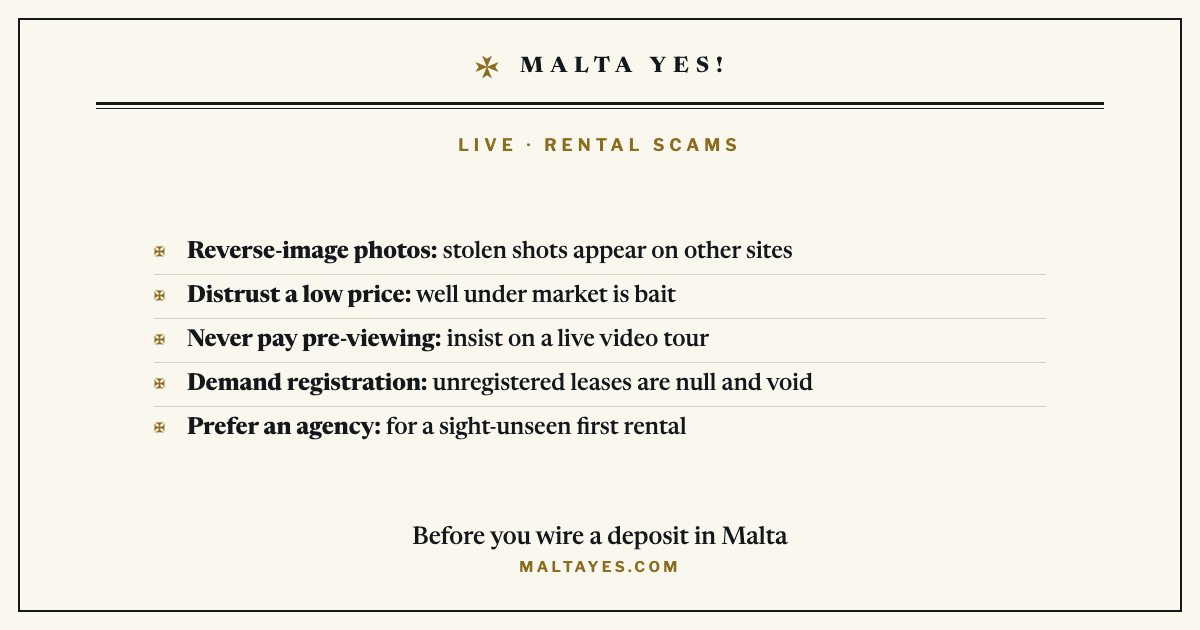
If you are arranging a Malta flat from overseas and a listing looks too good, three quick checks catch most scams before you lose a cent: reverse-image-search the photos, treat any price well below the going rate as bait, and never pay a deposit before a live video viewing. Those cover the common cons. The backstop, if a tenancy does go ahead, is Malta’s law: a private residential lease must be registered with the Housing Authority, and an unregistered agreement is null and void, giving you no protection at all.
This is the safety companion to our guide on renting a flat in Malta for a month or three: that piece covers where to look and what it costs; this one is about not being defrauded before you have keys in your hand. Malta’s rental scams are real and documented, and they follow patterns you can learn to spot.
Key facts
- Malta has real, documented rental scams. One convicted repeat offender rented flats short-term, cut a spare key, then “showed” the same flat to many people and took a deposit from each before vanishing.
- The classic red flags: stolen or altered photos, a price well under the market, a “landlord” reachable only on WhatsApp and never by phone, contracts full of grammatical errors, and pressure to pay into a foreign or online account before any viewing.
- Your real legal protection is registration. A lease for a main home must be registered with the Housing Authority within 30 days of starting (the window used to be 10 days).
- Registration is cheap and on the record: €10 to register, €5 to renew, with a €120 late fee if filed after 30 days — enforced since 1 September 2025.
- An unregistered lease is null and void. The landlord cannot enforce it — cannot chase unpaid rent or evict through the courts — and you can register it yourself and bill the cost back.
- Landlords who never register risk €2,500–€10,000 fines per contract, and every lease must include a signed inventory backed by photos, or the Authority can reject it.
The two-minute gut check
Before you reply to a listing, spend two minutes on three questions. First, are the photos real and unique to this property? Drop the main images into a reverse-image search; if the same shots appear on other listings, in other countries, or on a stock site, walk away. Second, is the price believable? A flat priced noticeably below similar places nearby is the oldest bait there is — scammers use a low headline figure to rush you into paying before you think. Third, is there a real, contactable person behind it? A genuine landlord or agency will happily take a phone call and a video tour; a “landlord” who exists only in WhatsApp text and cannot be reached by voice is a warning in itself.
Red flags in the message itself
Once you are talking to a supposed landlord, the message thread gives a lot away. A documented wave of scams aimed at overseas arrivals — including at least ten reported cases affecting French newcomers in a single year — shared a clear fingerprint: contact through Facebook groups, a “landlord” reachable only on WhatsApp and never by phone, property photos that had been stolen or subtly altered, contracts riddled with grammatical errors, and a request to send money to an online or foreign bank account before any viewing had taken place. Any one of these is a reason to slow down. Two or more together, and you are almost certainly looking at a scam. The single hardest rule to keep, because refusing feels rude, is this: never send money before you have seen the place live, on video if you cannot be there in person.
Verifying the photos and the person
Two checks defeat most of these. For the photos, a reverse-image search takes seconds and catches the lazy scams that reuse pictures from other listings. For the person, insist on a live video walk-through of the actual flat — not a pre-recorded clip — and ask them to show identification on the call. A real landlord or agent has no reason to refuse either. If they will not video-call the property, treat it as fake, however good the excuse. Scammers rely on your being far away and in a hurry; a live video tour removes exactly the distance they are exploiting.
The one real legal protection: Housing Authority registration
Malta gives you a genuine backstop, and it is worth understanding because most global scam guides miss it entirely. Under the Private Residential Leases Act (Cap. 604), a lease for a primary residence must be registered by the landlord with the Housing Authority, online through the official portal, within 30 days of the lease starting. That window was extended from the original 10 days by a 2024 amendment, so some older — and even some official — summaries still quote the 10-day figure; the current rule is 30 days, with a €120 late-registration fee that has been enforced since 1 September 2025. Registration itself is cheap: €10 normally, €5 for a renewal. Since the 2024 change, every lease — furnished or not — must also include a signed inventory backed by photographic evidence, submitted at registration; the Authority can reject a registration that arrives without one.
| Registration at a glance | Detail |
|---|---|
| Who registers | The landlord (a tenant may do it if the landlord fails to) |
| Deadline | Within 30 days of the lease starting |
| Cost | €10 to register, €5 to renew |
| Late fee | €120 if filed after 30 days (since 1 September 2025) |
| Also required | Signed inventory with photographic evidence |
Registration matters here for a simple reason: it puts your tenancy on an official record, with an agreed inventory and photos, held by a government authority. That is the opposite of a WhatsApp-only deal with someone who will not video-call the flat.
What “unregistered” actually costs you
An unregistered lease is not a weaker contract; in law it is null and void. The practical effect protects the tenant more than the landlord: an unregistered landlord cannot enforce the agreement through the courts, which means they cannot legally chase you for unpaid rent or evict you on the strength of it. If a landlord fails to register, you can register the contract yourself and bill the cost back to them. Landlords who skip registration entirely also expose themselves to separate fines of €2,500–€10,000 per contract. None of this helps against a pure fraudster who takes your deposit and disappears — that is what the checks above are for — but for a real landlord cutting corners, registration is the lever that keeps you protected. It sits in the same family of rules as Malta’s tightened short-let regulations, part of a broad move to put private lettings on the record.
If you have already paid
If you have sent money and the other side has gone quiet, act quickly but be realistic. Report it to the police: Malta does prosecute these cases — in the documented repeat-offender case there was a “long queue” of victims filing reports at the local station — but recovering a deposit wired to a foreign or online account is genuinely hard, which is why prevention matters so much. If instead you have a real but unregistered tenancy, register it yourself through the Housing Authority portal and recover the cost from the landlord. For a first rental arranged from overseas, the lowest-risk route is to go through an established local agency (Dhalia, Frank Salt, RE/MAX and Quicklets are the usual names), where the agency’s own lawyer drafts the contract and the agent signs as a witness. There is no official landlord blacklist in Malta — keeping one is actually illegal — so you cannot outsource the check; going through a reputable agency, or choosing school-arranged accommodation where you deal with the school rather than an unknown landlord, is how you buy back some of that safety. When you do pay, send it from an account you control and can trace — see our note on banking for a long stay — and pair it with the day-one admin of getting a local phone number so your accounts and verifications are properly yours.
Frequently asked questions
How do I know if a Malta rental listing is fake?
Run three checks before you engage. Reverse-image-search the photos; if they appear on other listings or a stock site, walk away. Compare the price to similar flats nearby; a figure well under the going rate is bait. And insist on a phone call and a live video tour of the actual flat. Scams targeting overseas arrivals lean on WhatsApp-only "landlords", stolen photos and pressure to pay before viewing.
Is my Malta rental contract legally required to be registered?
Yes. A lease for a main home must be registered by the landlord with the Housing Authority within 30 days of the start, through the official portal. Registration costs €10 (€5 to renew), with a €120 late fee for contracts filed after 30 days, enforced since 1 September 2025. The lease must also include a signed inventory with photos. The deadline was extended from an earlier 10-day window, so ignore sources still saying 10 days.
What happens if my landlord doesn't register the lease?
An unregistered lease is null and void, which in practice works in the tenant's favour: the landlord cannot enforce it through the courts, so they cannot legally pursue you for rent or evict you on its basis. If your landlord fails to register, you are entitled to register the contract yourself and bill the cost back to them. Landlords who never register also risk separate fines of €2,500–€10,000 per contract, so registration is genuinely in their interest too.
Can I get my deposit back if I was scammed renting in Malta?
Be realistic. If you wired a deposit to a foreign or online account for a flat that never existed, recovery is hard — though still report it to the police, who do prosecute these cases in Malta. The stronger position is prevention: never pay before a live video viewing, and use an established agency for a first rental. If instead your landlord is genuine but simply has not registered, you are protected, and can register it yourself and reclaim the fee. ---