
live
'Building a triathlon or Ironman base in Malta: open-water swim spots, bike
Planning triathlon training in Malta? Swim calm at Sliema (not Golden Bay), respect roads with 17 deaths by mid-2025; no TT or turbo trainer to rent.
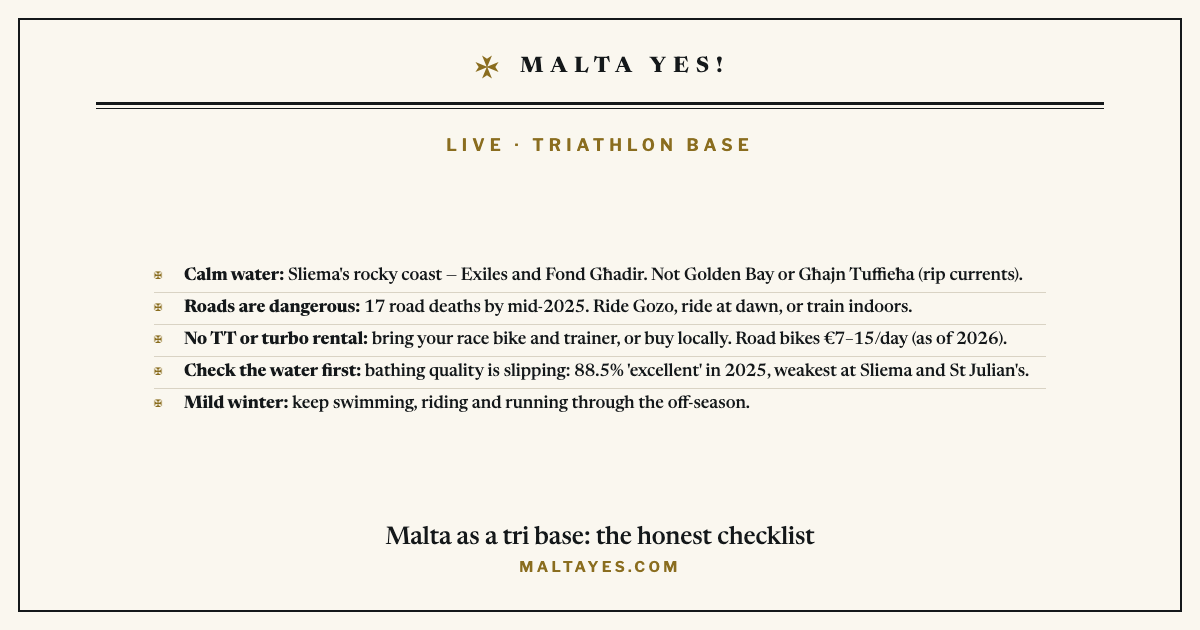
Malta works as a winter triathlon base, just not the way a training-camp brochure would sell it. You can swim, ride and run here almost all year, and the island has a real federation, a decades-old race series and even two Ironman World Championship qualifiers to its name. The honest picture, though, turns on three things a glossy guide skips: which water is actually calm, how dangerous the roads really are, and the fact that nobody here rents a time-trial bike or a turbo trainer.
Key facts
- The scene is real. The Malta Triathlon Federation is based in Gżira; a long-running Salina sprint series has produced two Ironman World Championship (Kona) qualifiers. Half-Ironman “Challenge Malta” ran once (2022), its 2023 edition was cancelled, and it is now discontinued.
- Calm water is limited. Sliema’s sheltered rocky coast (Exiles, Fond Għadir) is the genuinely calm swim. Golden Bay and Għajn Tuffieħa are not calm — they carry rip-current and undertow risk, with lifeguards only mid-June to September.
- Roads are the real constraint. Malta recorded 17 traffic deaths by 30 July 2025, already above the full-year totals for 2023 and 2024; roads like the Coast Road have no segregated cycling provision.
- No TT bike or turbo to rent. Road bikes hire for roughly €7–15/day (e.g. Elite Cycles, helmet and lock included, as of 2026), but no dedicated time-trial-bike or turbo-trainer rental exists — bring your own or buy.
- Water quality is slipping. 88.5% of official sites were rated “excellent” in 2025, down from 92% (2024) and 94.3% (2022); the weakest are St Julian’s, Sliema and parts of St Paul’s Bay and Qawra.
- The winter is the selling point. Mild highs of about 15–18°C let you keep training through the months northern Europe freezes: train here, race abroad.
Does Malta actually have a triathlon scene?
Yes, and it is older and more serious than most visitors assume. The Malta Triathlon Federation, based at the national pool complex in Gżira, runs a national championship series — including a middle-distance race over 1.5 km swim, 60 km bike and 15 km run, held at Salina in Naxxar. The 2026 edition ran in early May; if you are timing a stay around it, confirm the 2027 date, which was not yet published as of August 2026.
The deeper evidence is the Salina sprint series run for over twenty years by the Birkirkara St Joseph’s club, which has put two athletes on the start line at the Ironman World Championship in Kona — Dermot Galea and Rudolph Agius. That tells you what Malta is good for: building fitness to race abroad, not a destination race calendar in itself. Long-distance racing here has been fragile. Challenge Family’s half-Ironman “Challenge Malta” ran just once, in 2022; its 2023 edition was cancelled over course-safety concerns, and the race is now discontinued. So the realistic model is simple — train on the island, then race your Ironman or 70.3 somewhere else, with Sicily and mainland Italy an easy hop away.
If you want to train with others, the federation and its clubs run open sessions and welcome visitors, though it is worth emailing ahead. For organised races you will usually need a day licence or membership, and a club can tell you which winter swim and turbo sessions a long-stayer can realistically join.
Open water: what is calm, and what is not
This is where a lot of guides — and the original brief for this piece — get it wrong. Golden Bay and Għajn Tuffieħa, the postcard sandy bays in the north-west, are not the safe, current-free swim they look. Both carry documented rip-current and undertow risk, which is worse outside summer, and they are only lifeguarded from mid-June to September. They are fine for a warm-weather dip, but the wrong place to log solo distance off-season.
The genuinely calm option is Sliema’s sheltered rocky coast, along Exiles and Fond Għadir. The water is protected, you enter off the rocks or ladders rather than through surf, and you can sight along a consistent stretch — ideal for aerobic swim volume. For the practical detail — where to change, where the ladders are, how the rocks lie underfoot — see our guide to Malta’s rocky beaches, and treat this as the training-specific overlay: loop length, sighting lines and seasonality.
Two checks before every swim. First, water quality is trending down: 88.5% of Malta’s sites were rated “excellent” in 2025, from 92% the year before, with St Julian’s, Sliema and parts of St Paul’s Bay and Qawra the weakest — check the current status rather than assume. Second, watch for jellyfish and wind; a sheltered spot on a still morning is a very different swim from the same spot in an afternoon blow.
Road cycling, honestly
There is no soft way to put this: the roads are Malta’s biggest training weakness, and it is a safety issue, not a comfort one. The island recorded 17 traffic deaths by 30 July 2025, already more than the whole of 2023 or 2024, and the advocacy group Rota singles out high-speed shared roads such as the Coast Road, where there is no segregated cycling provision and traffic moves at 60–80 km/h. That the one serious long-course race here was cancelled over course safety is not a coincidence.
You can still ride, but you have to manage it. The two reliable tactics are riding at dawn, before the traffic builds, and heading to Gozo, which is quieter, greener and better suited to steady road miles; the crossing is short once you know how it works — see the Gozo ferry, decoded. For structured work — intervals, threshold, race pace — most athletes here ride indoors on a trainer with Zwift or similar, which also sidesteps the wind. Getting to a ride start or carrying a bike without a car is its own question, covered in do you need a car in Malta?.
The run leg
Running is the easy part of the three, so we will not duplicate what is already covered. Malta has genuinely good, low-traffic running once you are off the main roads: coastal paths, clifftop tracks and quiet inland lanes. The main things to plan for are heat and hard, uneven ground. For routes, surfaces and how to handle the temperature, see trail running in Malta; for a concrete example of the terrain, the Xemxija to Għajn Tuffieħa coastal trail is a good gauge of what a long off-road run here feels like.
Bikes: bring it, rent it, or train indoors
Your bike decision depends on what training you actually need to do.
| Option | Cost | Best for |
|---|---|---|
| Bring your own | Airline baggage (often within your allowance if boxed) | Race-specific work; if you need your TT bike, this is the only way to have one |
| Rent a road bike | About €7–15/day (e.g. Elite Cycles, as of 2026) | Steady road miles on Gozo or at dawn, without shipping a bike |
| Buy a trainer | Smart trainers are sold locally, not rented | Structured indoor sessions all winter — the workaround for the roads |
The key logistics fact is what Malta does not offer: no dedicated time-trial-bike rental, and no turbo-trainer hire. Standard road-bike rental is well established (Elite Cycles lists road bikes at about €7–15 a day, helmet and lock included), but if your block needs aero-position work or reliable indoor intervals, you must bring your own kit or buy a trainer here — smart trainers are sold, not rented. Sort this before you fly.
Building a block around Malta’s mild winter
The reason to be here at all is the calendar. While northern Europe is dark and frozen, Malta sits at daytime highs of roughly 15–18°C, so you can keep swimming, riding and running through the off-season — the same logic that sends athletes to Lanzarote or Mallorca. The best natural window is October to March.
Play to the island’s strengths and around its weaknesses. Use the mild winter for aerobic base — open-water swim volume, long steady runs, trainer blocks for the bike — and save race-specific outdoor riding for safer roads elsewhere, or for early mornings and Gozo. Treated that way, Malta is a strong, cheap winter base; treated as a place to hammer road intervals in traffic, it is a poor and risky one. The athletes who get the most from it are honest about which is which.
Frequently asked questions
Is there an Ironman race in Malta?
No branded Ironman event is held in Malta. The half-Ironman-distance "Challenge Malta" ran once, in 2022; its 2023 edition was cancelled over course-safety concerns, and the race is now discontinued. The Malta Triathlon Federation does run its own national championships, including a middle-distance race (1.5 km swim, 60 km bike, 15 km run) at Salina. In practice, athletes based here train on the island and race their Ironman or 70.3 abroad.
Is Malta good for triathlon training?
For winter base-building, yes — with clear caveats. The mild winter lets you swim, ride and run when northern Europe is frozen, and the swimming and running are genuinely good. But the roads are dangerous, calm open water is limited to sheltered spots like Sliema, and there is no TT-bike or turbo-trainer rental. It is excellent for aerobic base and swim volume, and weak for race-specific outdoor bike work.
Where can you swim open water in Malta?
Sliema's sheltered rocky coast — Exiles and Fond Għadir — is the genuinely calm option, with easy entry off the rocks and a consistent stretch to sight along. Golden Bay and Għajn Tuffieħa look inviting but carry rip-current and undertow risk, and are only lifeguarded from mid-June to September. Check bathing-water quality first: 88.5% of sites rated "excellent" in 2025, with Sliema and St Julian's among the weakest.
Is it safe to cycle in Malta?
Not on the main roads, honestly. Malta recorded 17 traffic deaths by 30 July 2025, already above the full-year totals for 2023 and 2024, and busy roads like the Coast Road have no segregated cycling provision. You can ride more safely by going out at dawn, heading to quieter Gozo, or doing structured sessions indoors on a trainer. Treat road riding here as something to manage carefully, not something to take for granted. ---