
explore
Camping in Malta: where you can legally pitch a tent
Wild camping in Malta means designated sites and a permit, not pitch-anywhere. The legal spots, the ~€10 Mellieħa permit, and when you can actually go.
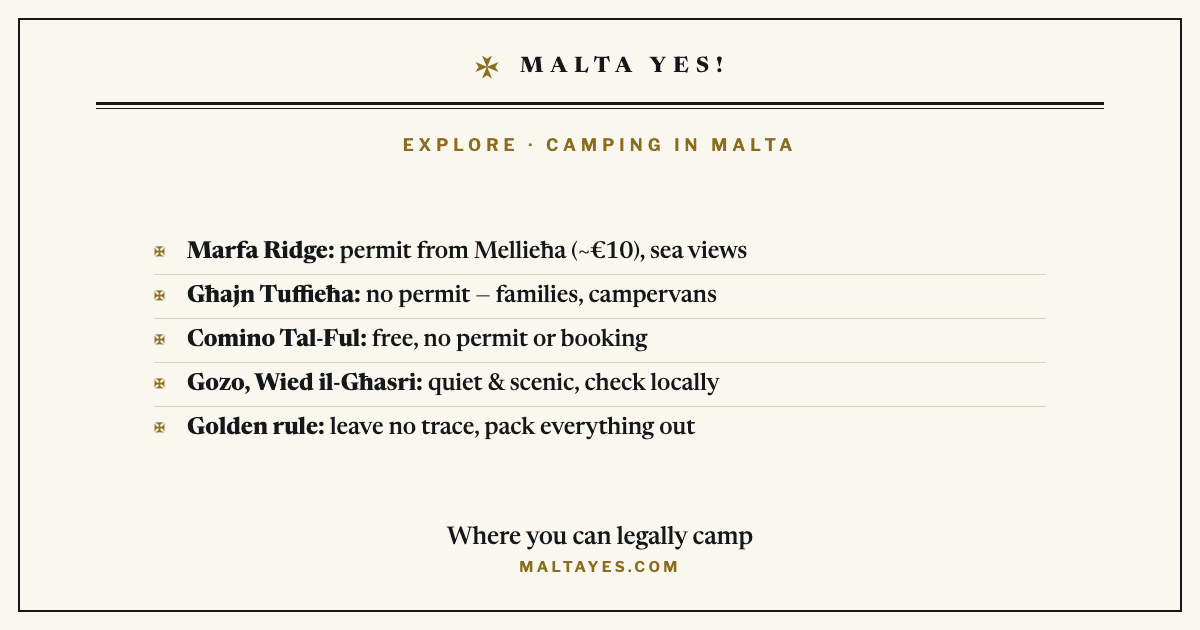
Malta isn’t the first place most people picture for a camping trip, but you can absolutely sleep under the stars here — as long as you do it in the right place, with the right paperwork. The one thing to get straight first: this is not a wild-camping free-for-all. You can’t just pitch a tent on any quiet clifftop or beach. Camping is allowed in designated areas, usually with a permit, and the rules are taken seriously. Here’s where you can legally camp, how to get the permit, and when to go.
Camping in Malta, in brief
- Wild camping: not a free-for-all — designated areas and permits only
- Main spot: Marfa Ridge / L-Aħrax in the north, permit from Mellieħa council (€10, or €40 at short notice)
- Campsites: Għajn Tuffieħa (good for families and vans); the free Tal-Ful site on Comino
- Best seasons: late spring to early summer at the Marfa zones — permits pause for the autumn–winter hunting season (~Sep–Jan); summer is hot with little shade
- Golden rule: leave no trace — pack out everything, damage nothing
Is wild camping legal in Malta?
Not in the “pitch anywhere you like” sense. You cannot camp on private land without the owner’s permission, and you cannot camp freely in protected nature areas — anything inside a Natura 2000 site needs sign-off from ERA (the environment authority), especially for groups. What you can do is camp in the areas set aside for it, usually after getting a simple permit from the local council. Malta’s Ranger Unit oversees the countryside and can clarify what’s allowed in a given spot. The recurring theme in every rule is leave no trace: don’t clear vegetation, don’t damage protected trees, and take all your rubbish home.
Where you can camp
The best-known option is Marfa Ridge / L-Aħrax, the peninsula at Malta’s northern tip near Mellieħa. It’s an open, scrubby headland with sea views and a few shaded, wooded pockets, and it’s genuinely popular with local campers — especially in summer. Camping here is organised into three designated zones (l-Aħrax tal-Madonna, l-Aħrax tat-Tunnara and l-Aħrax tar-Ramel), and you need a permit from the Mellieħa council first (€10, or €40 if you apply at short notice). One thing the guidebooks rarely mention: the council does not issue camping permits for these wooded zones during the autumn–winter hunting season (roughly 1 September to the end of January), and there’s a further short closure during the spring hunting window in April. So the flagship site is really a spring-to-summer option, not a year-round one.
For something with actual facilities, Għajn Tuffieħa has a campsite run by the Scout Association of Malta and open to the public: marked plots with water and electricity, toilets and showers, and room for caravans and campervans, near one of Malta’s nicer sandy bays. You book a plot online rather than turn up on spec. It sits at one end of the coastal walk through Majjistral, Malta’s only nature park, if you want to stretch your legs.
Comino — the tiny island between Malta and Gozo — has one designated campsite, at Tal-Ful, which is free and needs no permit or booking. It’s about as away-from-it-all as Malta gets once the Blue Lagoon day boats have left, and because it sits outside the Mellieħa permit system it stays open when the mainland hunting-season closures shut the Marfa zones. Fires are not allowed. If you’re weighing up a Comino trip generally, see our guide to the Comino visitor cap.
On Gozo, there are quiet, scenic spots on the north coast around the Wied il-Għasri valley — dramatic and secluded, though facilities are minimal. Getting there means the Gozo ferry.
How to get a permit
For the Marfa/L-Aħrax zones, permits come from the Il-Mellieħa council through Malta’s online permit system. In short: register on the permits site, choose the Mellieħa council, find the camping permit, and pick your zone. It costs €10, rising to €40 if you need it processed at short notice (within 48 hours), so apply a few days ahead. Note that permits for the main wooded zones simply aren’t granted during the hunting-season closures (see “When to go” below), so check your dates before you plan around them. One quirk worth knowing: the system is built for residents and expects a Maltese ID, which can be fiddly for visitors — worth starting early and contacting the council if you get stuck. To reach these northern spots and the ferries, a car helps a lot; here’s whether you need one in Malta.
When to go
Timing depends a lot on where you’re camping. For the Marfa/L-Aħrax zones, the practical window is late spring to summer: permits aren’t issued during the autumn–winter hunting season (roughly September to the end of January), and there’s a short spring closure in April too, so the “spring and autumn” advice you’ll see on other sites doesn’t hold for the flagship spot. May and June are the sweet spot there — warm but not yet brutal. Summer (July and August) is when many locals camp at Marfa, but the heat is intense and there’s little shade; it’s the same treeless, shadeless coast that makes trail running in Malta an October-to-May pursuit, so if you camp in high summer, plan for sun and carry plenty of water. Comino’s Tal-Ful site and the Għajn Tuffieħa campsite sit outside the council permit system, so they stay open in autumn if that’s the only time you can come. Winter can be surprisingly cold and windy on exposed headlands.
What to bring, and the leave-no-trace rules
Facilities at most spots are minimal to none, so come self-sufficient: water, a way to cook, sun protection, and a first-aid kit. Open fires are restricted or banned in most areas, so plan to use a camping stove rather than a campfire. And the rules that matter most are the environmental ones — don’t pitch on protected plants, don’t cut vegetation, don’t tie ropes to protected pine trees, and carry every scrap of rubbish out with you. Malta’s wild spots are small and heavily used; leaving no trace is what keeps them open to campers at all.
Prefer a roof? Glamping
If a tent and a permit sound like more effort than you want, Malta and Gozo have a growing number of glamping and eco-lodge options — bell tents, pods and farmhouses with proper beds — that give you the outdoors feel with none of the paperwork. It’s a comfortable middle ground, especially for a first trip or in the hotter months.
Frequently asked questions
Is wild camping legal in Malta?
Not in the sense of pitching a tent wherever you like. Camping is restricted to designated areas and usually needs a permit — you can't camp on private land without the owner's permission, or in protected Natura 2000 areas without ERA approval. The Malta Ranger Unit oversees the countryside. Camp only where it's allowed, get the permit, and always leave no trace.
Where can you camp in Malta?
The main spot is Marfa Ridge / L-Aħrax in the north (permit from Mellieħa council), which has three designated zones and sea views. Għajn Tuffieħa has a Scout-run campsite suited to families and campervans, Comino has a free designated site (Tal-Ful), and Gozo has quiet spots near the Wied il-Għasri valley. Facilities range from basic to none, so come prepared.
Do you need a permit, and how much does it cost?
For the Marfa/L-Aħrax zones, yes — a permit from the Il-Mellieħa council via Malta's online permit system, costing €10 (€40 for rush processing within 48 hours). Apply a few days ahead, and note permits aren't issued for the main zones during the hunting-season closures. Comino's Tal-Ful campsite doesn't require a permit. Always double-check current rules with the council before you go.
When is the best time to camp in Malta?
It depends on the site. The main Marfa/L-Aħrax zones are a spring-to-summer option only: permits aren't issued during the autumn–winter hunting season (roughly September–January), with a short closure in April too. May and June are ideal there. Summer is hot with little shade, so bring water and sun cover. Comino and the Għajn Tuffieħa campsite stay open in autumn.
Can you camp on Comino?
Yes, at the island's one designated campsite, Tal-Ful, and you don't need a permit or booking for it. Fires aren't allowed. It's one of the quietest places to camp in Malta once the Blue Lagoon day-trippers have gone home, and because it's outside the Mellieħa permit system it stays open in autumn — but bring everything you need, as the island is almost entirely undeveloped.