
explore
'Malta''s record July 2026 heatwave: is an August trip still worth it, and
Malta's record 43.3°C July heatwave has eased. The honest August 2026 picture: is it too hot to visit, will power cuts hit hotels, and how to cope.
Yes — if you already have an August 2026 trip to Malta booked, it is still worth going, and there is no need to cancel. The record heat that filled the headlines came in one short, fierce spell from 18 to 23 July, and it has since eased. What you do need is a plan, because Malta in August is genuinely hot, and this summer the whole Mediterranean is running hotter than usual.
This guide is for a visitor who has a flight or a course booked and has just read something alarming. We will go through what actually happened, with real dates and numbers; whether it is still that hot right now; the power cuts and what they mean for your hotel’s air conditioning; and the simple ways to stay comfortable. If your worry is broader than the weather, our honest read on whether Malta is safe sits alongside this one. The short version on the heat: go, but go prepared.
Key facts (as of 2 August 2026)
- The record: Malta reached 43.3°C on 18 July 2026 — its hottest July day on record, and just 0.5°C below the all-time national record of 43.8°C set in August 1999.
- A record streak: three days in a row at or above 42°C, the longest such run ever recorded here. The Meteorological Office issued a Red Weather Warning, its highest heat alert.
- It has eased. As of early August the Met Office forecasts around 34–36°C, feeling like up to 38°C, under a lower yellow warning — hot, but within Malta’s normal peak-summer range.
- The power cuts came with record electricity demand (over 700MW, beating the 663MW record from 2023) and hit at least 16 localities for short periods. The network has since stabilised.
- This is a Mediterranean-wide “heat dome”, not a Malta-only fault — so expect more short hot spells through August.
- Drinking water is not at risk: over half of Malta’s supply comes from desalination.
What actually happened in July
On Saturday 18 July 2026, the temperature reached 43.3°C — the hottest July day in Malta’s records, and only half a degree below the national all-time high of 43.8°C, recorded back in August 1999. It was not a one-day spike, either. Malta had three consecutive days at or above 42°C, the longest run of that intensity ever recorded, beating the previous July record of 42.7°C (last equalled in July 2023). The Meteorological Office issued a Red Weather Warning, the top level of its heat alert scale.
That is a serious heatwave by any measure, and the coverage was not exaggerating it. The important thing for a visitor, though, is that this was a defined spell — roughly 18 to 23 July — not a permanent new normal for the whole summer.
Is it still this hot right now?
No. The seven-day heatwave broke around 23 July, and temperatures have come down to more usual peak-summer levels. As of early August, the Met Office forecasts highs of about 34–36°C, with a “feels-like” figure of up to 38°C, and only a yellow warning in force — two steps below the red alert of mid-July — running into at least the first week of the month.
| Mid-July peak (18–23 Jul) | Now (early August) | |
|---|---|---|
| Daytime high | up to 43.3°C (record) | ~34–36°C (normal for summer) |
| Feels-like | dangerous | up to ~38°C |
| Weather warning | Red (highest) | Yellow (lower) |
| Power cuts | short, localised cluster | network stabilised |
To put that in perspective, 34–36°C is a hot Maltese August day, not a record-breaker. It is the kind of heat the island handles every single summer. The wider picture is that a Mediterranean “heat dome” has settled over the region this year, so more short hot spells are likely across August — a regional pattern, not a Malta-specific problem. If you genuinely dislike heat and your dates are flexible, it is worth knowing that Malta is a completely different, mild-weather destination in the quiet off-season from November to March. But for a fixed August trip, the answer is to plan around the heat rather than fear it.
The power cuts: should you worry about your hotel’s air conditioning?
The most alarming headlines were about power cuts, so it is worth being clear about what caused them. During the peak, national electricity demand hit a new record of over 700MW — well above the previous peak of 663MW set in 2023 — as air conditioners ran flat out across the island. Enemalta, the national energy company, was clear that it had enough generating capacity: the cuts came from heat and demand stressing underground cables and the distribution network, not from a shortage of power. Faults were repaired under a multi-year network investment programme, and the government pledged compensation to affected households and businesses.
For a visitor, the practical takeaways are reassuring. The cuts were short and localised — hitting particular streets and localities for a time, not the whole island at once — and they clustered around the demand peak of 20–22 July, since when the network has stabilised. Larger hotels generally run on more robust supply and often have backup arrangements. The sensible move is simply to choose accommodation with reliable, confirmed air conditioning, and to ask, when booking, what happens in the rare event of a local outage. It is a factor to check, not a reason to stay away.
How to handle the heat: the official advice
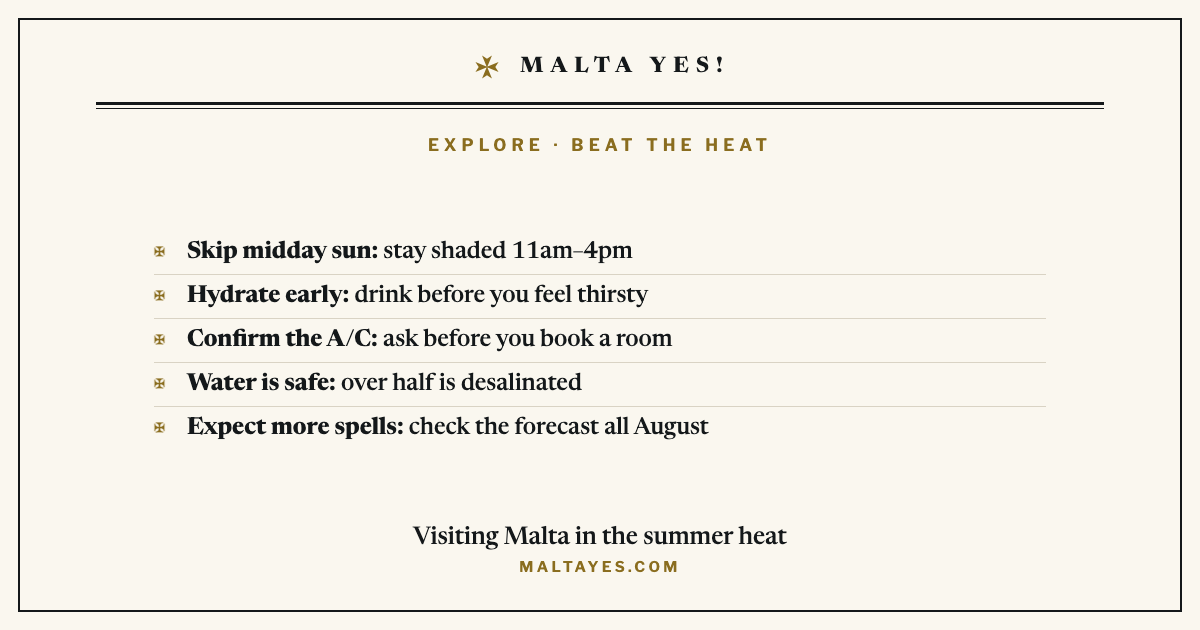
Malta’s health authorities run a “Beat the Heat” campaign, and its advice is simple and worth following:
- Stay out of direct sun between 11am and 4pm — the hours when the heat does real harm.
- Drink water before you feel thirsty, and keep a bottle with you.
- Look out for the more vulnerable — older travellers, small children, anyone with a health condition. During the July peak, the authorities also opened cooling centres for vulnerable residents.
For a visitor, this shapes the day naturally. Do your sightseeing and any outdoor activity early or late, in the morning and the cooler evening hours, and keep the middle of the day for indoor plans: a long lunch, a museum, or a proper siesta like the locals. If you are set on a serious walk, our guides to the Dingli Cliffs and Victoria Lines and to trail running in Malta both say the same thing about summer — start at dawn, carry two to three litres of water each, or save the route for the cooler months. And rather than walking across town at midday, it is often worth taking an air-conditioned Bolt or eCabs instead.
Hotel vs self-catering: check the air conditioning before you book
Air conditioning is the single thing that makes an August stay comfortable, so treat it as a booking criterion, not an afterthought. In hotels, central air conditioning is standard and generally reliable; with the larger ones, it is worth asking whether they have backup power. In self-catering apartments, the quality varies enormously, and this is where people get caught out.
Before you book a flat, confirm three things: that the air conditioning is in the bedrooms (not just a single unit in the living room), that it is included in the price rather than metered as a costly extra, and that it is modern and actually works. A quick message to the host asking these exact questions tells you a lot. A place with weak or expensive cooling is miserable in an August heatwave, however good it looks in the photos.
Beaches, shade and cooling off
The sea is your best friend in this weather, and at this time of year it is warm and inviting. Swim early or late to dodge the fiercest sun, stick to shaded spots or a beach club with sunbeds and umbrellas over the middle of the day, and reapply sun cream far more often than feels necessary. If the famous Blue Lagoon on Comino is on your list, go first thing in the morning — you beat both the worst heat and the crowds, and you will want to check the Blue Lagoon visitor rules for 2026 before you set off. Wherever you end up, keep drinking water: the tap and bottled supply is not under strain, since more than half of Malta’s water is desalinated.
Frequently asked questions
Is Malta too hot to visit in August 2026?
No — an August trip is still worth taking, as long as you plan around the heat. The record 43.3°C spell in mid-July has passed, and early-August temperatures of 34–36°C are normal for a Maltese summer. Keep out of the sun between 11am and 4pm, drink water constantly, book accommodation with reliable air conditioning, and do your outdoor sightseeing in the morning and evening. More short hot spells are likely, so check the Met Office forecast for your dates.
Why did Malta have power cuts in July 2026?
Because the extreme heat pushed electricity demand to a record above 700MW, well beyond the 2023 peak of 663MW, as air conditioners ran across the island. Enemalta said it had enough generating capacity; the cuts came from that demand and the heat stressing underground cables and the distribution network. The faults were repaired, compensation was pledged to those affected, and the network has since stabilised — so widespread cuts are not the expected norm for an August visit.
What is the hottest it has ever been in Malta?
Malta's all-time record is 43.8°C, set in August 1999. The 43.3°C reached on 18 July 2026 came within half a degree of that, and set a new record for the month of July specifically, beating the previous July high of 42.7°C. Malta also recorded three consecutive days at or above 42°C in July 2026 — the longest streak of that intensity in its records — which is what prompted the Red Weather Warning.
Do Malta hotels have reliable air conditioning?
Yes, as a rule — central air conditioning is standard in Maltese hotels and generally dependable, and larger properties often have backup arrangements for a local power cut. Self-catering apartments are more variable, so it pays to confirm the details before booking: that the cooling reaches the bedrooms, is included in the price rather than charged as an extra, and is modern enough to cope with a real heatwave. When in doubt, message the host and ask directly. ---