
explore
'Trail running in Malta after dark: beating the summer heat with a headlamp
Night trail running in Malta beats the 5am heat: August lows near 22°C. Which Mellieħa paths work after dark, headlamp lumens and the hunting-hours catch.
If you are training through a Maltese summer, you have already learned that midday is out. The usual advice is to set a 5am alarm and run before the sun has any bite. But there is a second option that gets almost no coverage: run at night. A headlamp-lit evening run solves the same heat problem without the brutal wake-up, and — once autumn’s hunting season opens — it can actually be the safer window of the two. This guide covers whether night running in Malta is sensible, which coastal paths near Mellieħa work after dark, what headlamp you need, and how it stacks up against the dawn alternative.
Key facts (as of 2026)
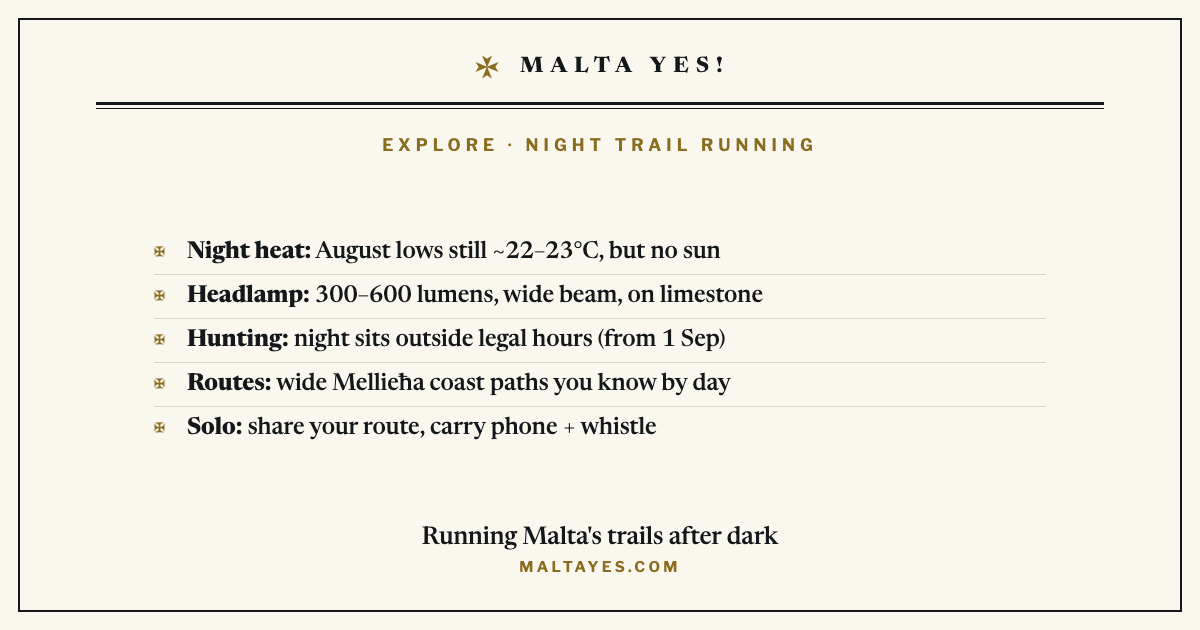
- The heat doesn’t fully lift — August highs run 29–31°C, but overnight lows only drop to about 22–23°C, with humidity averaging around 67%. Night is cooler, not cold. [VERIFY: aggregator data]
- You have real dark to work with — August sunset falls from about 8:09pm to 7:34pm across the month, so a genuine after-dark run is easy to time.
- Headlamp — roughly 200–300 lumens for wide, well-marked paths; 300–600 for technical or uneven ground, with a wide beam to avoid tunnel vision.
- Hunting hours — from 1 September, legal hunting runs two hours before sunrise to two hours after sunset. A true night run sits outside that window; a 5am run may not.
- Route — the Mellieħa–Xemxija coastal stretch has genuinely easy sections, but also steps and a headland climb near Ras il-Griebeg that demand care in the dark.
Why night can beat the 5am alarm
Three things line up in favour of running late rather than early. The first is simple heat: after dark the sun is gone, and while a Maltese summer night is not cold — lows sit around 22–23°C with high humidity — it is meaningfully cooler and, crucially, there is no direct sun cooking exposed limestone or your head. The second is consistency: a lot of runners who swear by dawn runs quietly skip half of them, because 5am is 5am. An evening run after dinner is far easier to actually do, week after week, which matters more for training than any single session’s perfection.
The third reason is specific to Malta’s calendar and is the one nobody mentions. From 1 September the autumn hunting season opens, and legal hunting hours run from two hours before sunrise until two hours after sunset. A true night run — well after dusk and finished before the pre-dawn window opens — falls entirely outside legal hunting hours. A 5am start in September does not: it can drop you straight into the pre-dawn hunting window. So once the season starts, the “safe, sensible” early run is arguably the more exposed one. Our guide to Malta’s autumn hunting and trapping season covers the dates and reserves in full.
Which coastal paths are genuinely night-runnable
Not every trail that is fine by day is fine by headlamp. The wide, well-trodden coastal paths around Mellieħa and St Paul’s Bay are the sensible place to run in the dark; narrow, technical single-track is not. The catch is that even the “easy” routes are not uniformly easy. The Mellieħa–Xemxija coastal stretch — the Xemxija Hill Heritage Trail and the Mistra Bay circular — has wide, flat sections you could run in the dark without much thought, but it also has flights of steps and a real headland ascent and descent near Ras il-Griebeg. Those are the parts to walk, or to avoid at night until you know them in daylight first.
The rule of thumb: run at night only on ground you have already run in daylight. Learn a loop when you can see it, note where the steps and drop-offs are, then run that exact loop after dark. Our first-person account of the Xemxija-to-Golden-Bay coastal run walks through this terrain in daylight, and the wider trail running in Malta guide covers the island’s routes and the shadeless-coast problem that makes summer running hard in the first place.
Headlamp and reflective gear for limestone
Your headlamp is the whole game after dark. General trail-running guidance is a good baseline: around 200–300 lumens is enough for wide, well-marked paths, while 300–600 lumens is better for technical or uneven ground. Malta’s coastal limestone is exactly the “uneven” case — pale rock, sudden steps, loose stone — so err toward the brighter end and choose a lamp with a wide beam rather than a narrow spot, because a wide beam reduces the tunnel vision that makes you miss a step at the edge of the light. Carry a spare light or a charged phone as backup; a dead headlamp on a headland is not the place to improvise. Add reflective clothing or a light on your back if any part of your route touches a road, since drivers are the real hazard wherever trail meets tarmac.
Safety basics after dark
Night running raises the stakes on the ordinary rules, so treat them as non-negotiable. Run with someone if you can — company is the single biggest safety upgrade at night. If you run alone, tell someone your exact route and rough finish time, and carry a phone and ideally a whistle. Stick to the ground you know. And be aware of one genuinely nocturnal-specific point: Malta’s creatures are barely a concern, but they are a different set at night. The island’s snakes are harmless — the leopard snake is non-venomous and the cat snake mild and shy — but Mediterranean yellow scorpions are more active after dark and recluse spiders live in the countryside, so watch where you put your hands if you stop and rest on rocks or walls. [VERIFY: wildlife risk drawn from general sources, not a Maltese natural-history authority.] Stray dogs are rare, though packs have been reported around some rural sites, another reason to favour the well-used coastal paths over remote inland tracks. [VERIFY]
What changes when hunting season opens
From 1 September the calculus shifts, and it shifts in night running’s favour. During the autumn season, legal hunting happens from two hours before sunrise to two hours after sunset — so the danger windows are dawn and dusk, not the middle of the night. This is the opposite of what most runners assume. A late, fully-dark run threads neatly between the two hunting windows. It is also worth knowing where hunting is banned outright: designated bird sanctuaries and the area within 200m of the airport, including Għadira, which sits right next to the Mellieħa coastal cluster, along with Simar and others. Running near Għadira keeps you on ground where hunting is not permitted at all — a sensible bias once the season is live.
Night versus the dawn run, honestly
Neither is perfect. A dawn run gives you the coolest air of the day and finishes before life gets busy, but it means a punishing alarm, and from September it can put you out during pre-dawn hunting hours. A night run is warmer than dawn and demands a headlamp and more care underfoot, but it is far easier to stick to, sits outside hunting hours, and turns a shadeless summer trail into a manageable one. If you are training seriously and struggling to keep dawn runs consistent, the honest answer is that the run you actually do beats the run you keep sleeping through. For the flip side of this — deliberately using Malta’s heat rather than dodging it — see our companion piece on heat-acclimatisation training for a desert ultra.
Frequently asked questions
Is it safe to run alone at night in Malta?
It can be, on the right ground and with the right precautions, but running with someone is always safer. If you go alone, stick to wide, well-used coastal paths you have already run in daylight, tell someone your route and finish time, and carry a phone and a whistle. Use a good headlamp and add something reflective if you cross any road. Malta's wildlife is a minor concern — harmless snakes, the occasional scorpion after dark — and the bigger risks are simply tripping on unlit, uneven limestone and traffic where a trail meets tarmac. [VERIFY]
What lumen headlamp do I need for Malta's coastal trails?
For wide, well-marked paths, roughly 200–300 lumens is enough. For the uneven, step-strewn limestone that makes up much of Malta's coast, aim higher — around 300–600 lumens — and choose a wide beam rather than a narrow spot so you can see the edges of the trail and not just a bright circle ahead. Carry a backup light or a charged phone. A brighter lamp with a wide beam is the single most useful piece of night-running kit here.
Does hunting season affect night running?
Less than you might think, and less than it affects dawn running. Malta's autumn hunting season runs from 1 September to 31 January, but legal hunting hours are only two hours before sunrise to two hours after sunset. A genuine night run, well after dark and finished before the pre-dawn window, falls entirely outside those hours. A 5am run in September can overlap the pre-dawn hunting window instead. Favour routes near bird sanctuaries such as Għadira, where hunting is banned outright.
What's the coolest time of day to run in a Malta summer?
The coolest air is around dawn, just before sunrise, when overnight temperatures have bottomed out — but even then August lows only reach about 22–23°C. Late at night is a touch warmer than dawn but still far better than daytime, with no sun on the rock. The practical answer is that both early morning and after dark work; pick the one you will actually stick to, and in September lean toward the night run to stay clear of pre-dawn hunting hours.