
explore
Malta's autumn hunting and trapping season: what hikers and trail runners should actually know
Is it safe to hike Malta's countryside from September to January? Hunting season on the trail: the dates, the protected reserves, and what to wear.
If you plan to hike or trail run in the Maltese countryside between September and January, you will be sharing it with hunters and trappers. This is legal, it is seasonal, and it happens here on a scale you will not have met anywhere else in Europe. The short answer to “is it safe?”: yes, you can still walk and run, but you should know the dates, stay on marked trails and inside the protected reserves, wear bright colours, and understand what nearby gunfire does and does not mean.
We are writing this because our own guides recommend September to November as Malta’s best walking and running season, and until now none of them mentioned that those same months are when the countryside fills with hunters. That is a real gap between our advice and the reality on the ground, and it is worth closing honestly.
Hunting season for hikers, in brief
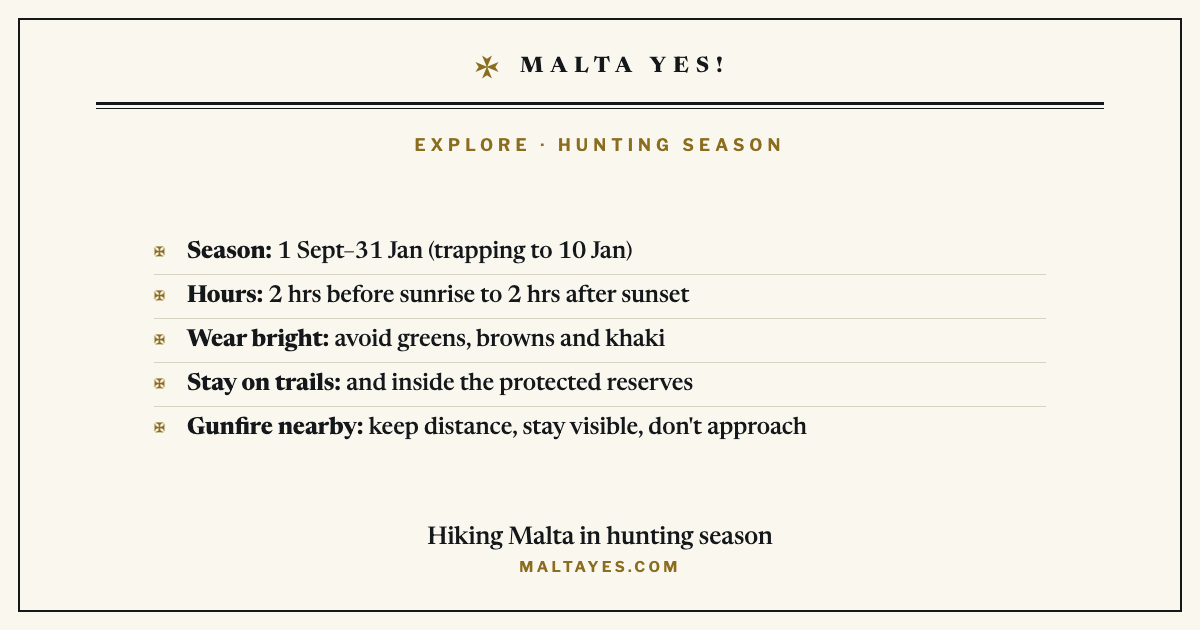
- Autumn hunting season: 1 September to 31 January, the same window every year
- Hunting hours: two hours before sunrise to two hours after sunset (until 1pm on Sundays and public holidays)
- Trapping season: 20 October to 10 January, using ground nets rather than guns
- Scale: about 44 registered hunters and trappers per square kilometre nationally, the highest density in the world
- Where you are protected: hunting and trapping are banned by law in the managed nature reserves
- Your two simplest protections: bright clothing, and staying on marked trails
Yes, hunting is legal in the Malta countryside, and here is what is allowed
Malta’s autumn hunting season runs from 1 September to 31 January, the same dates every year. In the most recent season it covered 40 species on land and 12 at sea. Hunters may shoot from two hours before sunrise until two hours after sunset, with an earlier finish at 1pm on Sundays and public holidays. That morning-and-evening pattern matters to you: the busiest hunting is around dawn and dusk, which is also when many runners like to be out to avoid the heat. Full daylight, mid-morning to mid-afternoon, is quieter.
One assumption worth correcting straight away: “hunting season” is not a tidy autumn-only window. Rabbit hunting runs separately from roughly June to the end of the year, so some hunting activity is realistically present in the Maltese countryside almost year-round, apart from a pause around February and March. The autumn bird season is simply when it is at its most intense and most visible.
The exact dates for each year are confirmed by a legal notice published just before 1 September. The 1 September to 31 January window has held unchanged for years, but if you are relying on a specific date, check the current notice before you go.
The numbers: why Malta has the world’s highest hunter density
The scale is the thing that surprises visitors, and it is worth stating plainly. In 2024 Malta had 10,029 registered hunters and 4,105 registered trappers. Spread across an island of 216 square kilometres, that is about 44 per square kilometre nationally, and over 60 per square kilometre once you exclude the built-up areas where nobody hunts. Both figures are cited as the highest hunter density anywhere in the world.
That does not mean you will meet a hunter every few hundred metres. It means the countryside is genuinely shared space during the season, in a way it simply is not in most of Europe. If you come from somewhere where hunting is a marginal, rarely-seen activity, calibrate your expectations upward: hearing shots and seeing hunters at the edge of a field is normal here, not a sign that something has gone wrong.
Hunting versus trapping: what is different, and when
These are two separate activities with different seasons, different methods, and different things for you to notice.
| Hunting | Trapping | |
|---|---|---|
| Season | 1 Sept – 31 Jan | 20 Oct – 10 Jan |
| Method | Shotguns | Clap-nets on the ground |
| Main targets | 40 land + 12 sea species | Song Thrush, Golden Plover (plus a finch “research” scheme) |
| What you notice | Gunfire, hunters in the open | Nets, small hides, decoys at ground level |
Trapping runs on a tighter calendar within the hunting window. In the most recent season, Song Thrush trapping ran 20–31 October, both Song Thrush and Golden Plover from 1 November to 31 December, and Golden Plover alone from 1 to 10 January. A separate “research” scheme allowed catch-and-release trapping of seven finch species from 20 October to 20 December. In 2025 the authorities registered 4,573 trapping sites across Malta and Gozo, made up of 1,641 clap-net sites and 2,932 finch “research” sites, all mapped publicly. The practical upshot for a walker: trapping sites are on the ground, often just off a path, and there are thousands of them, including on Gozo.
Where you are protected by law, and what “protected” does not guarantee
Hunting and trapping are banned by law inside Malta’s managed nature reserves. Għadira, Simar, Salina, Foresta 2000 and Buskett Woodlands are all legally protected, which makes them the most reassuring places to walk during the season. Routes that stay inside or close to these areas, and the well-marked coastal paths, are your safest choices from September to January.
Being honest, though: the legal protection is not an absolute guarantee of zero activity nearby. BirdLife Malta’s own reporting notes that illegal hunting continues, with protected birds still shot even during the legal season, including in countryside next to reserves. So “protected” means hunting is not permitted there, not that you will never hear a shot from an adjacent field. Treat the reserves as much safer, not as sealed.
There are also a few things you can learn to recognise, because some of what you might see is itself illegal. Electronic bird callers are banned at all times, though plastic decoys are legal. Unattended nets, trapping sites that are not on the official registered list, and cages holding live finches are all markers BirdLife itself flags as signs of illegal trapping. You do not need to become an inspector, and you should never interfere with someone else’s equipment, but knowing what you are looking at turns an unsettling scene into an understandable one, and gives you something concrete to report if you choose to.
Practical advice: what to wear, what gunfire means, what to do
The single most useful thing you can do is be visible. Wear bright colours, and avoid the greens, browns and khaki that read as camouflage or, worse, as game. A high-visibility layer, a bright cap or a loud running top does the job. This matters most at the low-light edges of the day when hunters are most active.
Stay on marked trails and, where you can, inside or near the protected reserves. Wandering off-path into scrub during the season is exactly how you end up somewhere a hunter did not expect a person to be. Keeping to established routes also keeps you away from the ground-level nets and hides.
On gunfire: hearing shots nearby during the season is normal, and is usually aimed low across fields or up at birds, not a sign of danger to you specifically. The right response is not to panic but to stay calm and stay obvious. If you can see active hunting close to your route, keep your distance, make sure you are visible, do not approach hides, nets or hunters, and carry on along the marked path rather than cutting across open ground. If you see something that looks illegal, such as unattended nets, caged finches or electronic callers, do not intervene: note the location and, if you wish, report it to BirdLife Malta or the police.
The honest picture, next to our own “best season” advice
None of this cancels the case for autumn. September to November is still, in our view, the best time to walk and run in Malta: the sea is still warm, the heat has broken, and the crowds have thinned. Hunting season does not change that so much as ask you to plan around it. Favour the protected reserves and well-marked coastal routes, go in full daylight rather than at dawn or dusk, wear something bright, and you can enjoy exactly the shoulder-season walking and running the rest of our guides recommend.
That applies to the routes we have already written up. The coastal walks along the Dingli Cliffs and the Victoria Lines, the Golden Bay to Għajn Tuffieħa path through Majjistral, and the longer coastal trail runs all cross open countryside where hunting takes place. None of them is off-limits in autumn. They are simply routes to walk in daylight, in bright kit, with the season in mind, rather than at first light in browns and greens.
Frequently asked questions
Is it safe to hike in Malta during hunting season?
Yes, with sensible precautions. Hunting is legal and common in the Maltese countryside from September to January, but you can walk and run safely by staying on marked trails, favouring the protected nature reserves, wearing bright colours, and going in full daylight rather than at dawn or dusk. Nearby gunfire is normal during the season and is not usually a sign of danger to you, but keep your distance from any active hunting you can see.
What months is hunting season in Malta?
The autumn hunting season runs from 1 September to 31 January every year, with hunting allowed from two hours before sunrise to two hours after sunset, and only until 1pm on Sundays and public holidays. Trapping runs from 20 October to 10 January within that window. Separately, rabbit hunting runs from around June to year-end, so some hunting activity is present in the countryside for most of the year, apart from a pause around February and March.
Are Malta's nature reserves safe from hunting?
They are the safest places to walk. Hunting and trapping are banned by law inside the managed reserves, including Għadira, Simar, Salina, Foresta 2000 and Buskett Woodlands. That said, the ban does not guarantee zero activity nearby: BirdLife Malta reports that illegal hunting still happens, including in countryside next to reserves. Treat the reserves as much safer, not completely sealed off, and stay on their marked paths.
What should I wear when hiking in the Malta countryside in autumn?
Bright, visible colours. Avoid greens, browns and khaki, which read as camouflage or game, and instead wear a high-visibility layer, a bright cap or a loud top so hunters can clearly see you are a person. Visibility matters most in the low light around dawn and dusk, when hunting is at its busiest, which is another reason to walk and run in full daylight during the season.
What does nearby gunfire mean when I am hiking?
During the season it usually means legal bird hunting in a nearby field, aimed low or skyward rather than at anything on the path. It is normal and not, in itself, a sign of danger to you. Stay calm, make sure you are visible in bright clothing, keep your distance from any hunting you can actually see, and continue along the marked trail instead of cutting across open ground towards the sound.