
explore
'Why September to November is Malta''s best season: the shoulder months that
Planning the best time to visit Malta? Autumn wins: sea still ~25°C in September, ~16% fewer visitors than August, and Notte Bianca on 3 October.
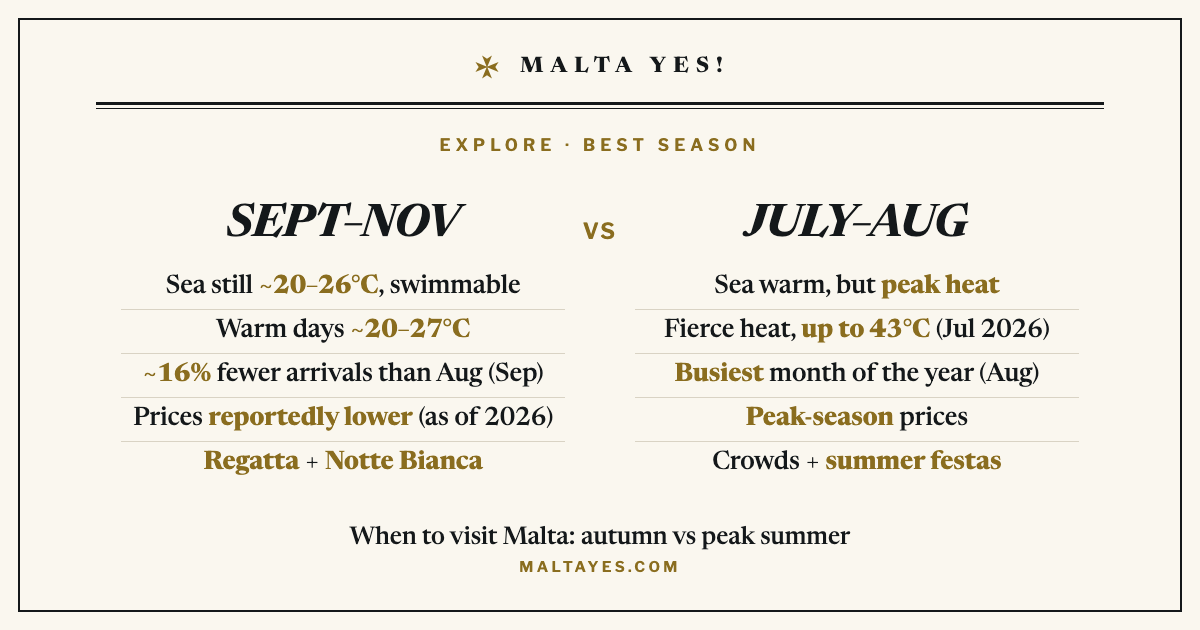
If your dates are flexible, the best time to visit Malta is not July or August but the September-to-November shoulder that most guides skip past. The sea is still warm enough to swim, the summer crowds and prices have dropped, and the calendar is full of real events, from Victory Day’s harbour regatta to the all-night Notte Bianca. Here is the honest case for autumn, month by month, and how to build a trip around it.
Key facts
- The sea stays swimmable into autumn: around 25–26°C in September, about 23–24°C cooling to 20–21°C through October, and roughly 20–22°C in November.
- Fewer people than August: Malta had 393,848 inbound visitors in September 2025 against 470,643 in August — about 16% fewer — and 417,103 in October, around 11% below August.
- Prices reportedly fall: hotels and flights are widely reported to drop 15–35% below August levels from mid-September, once the European school holidays end.
- Real dated events: Victory Day and the Grand Harbour Regatta on Tuesday 8 September 2026; Notte Bianca in Valletta on Saturday 3 October 2026.
- Food in season: lampuki (dolphin fish) runs from 15 August to the end of December and is at its best in September, which is also the grape harvest.
- Nature reopens: Għadira Nature Reserve, Malta’s main birdwatching wetland, reopens in September for the autumn migration.
Why September to November beats summer
Summer in Malta serves up peak heat, peak crowds and peak prices all at once. August 2025 was the busiest month of the year, with 470,643 inbound visitors. By September that had dropped to 393,848 — roughly 16% fewer people on the same beaches and bastions — and October, at 417,103, was about 11% quieter than August while still busy. Fewer visitors means shorter queues at the big sights, easier restaurant tables, and room to actually walk through Valletta.
The weather does the opposite of what you might fear. The sea holds its summer warmth long after the air cools, so swimming stays comfortable well into the autumn. And the punishing midsummer heat eases: Malta hit 43.3°C in July 2026, and the shoulder months trade that for warm days that are far kinder for walking cities and coast. If you are weighing up the heat, our guide to Malta’s record 2026 heatwave makes the direct contrast. Prices follow the crowds down too — hotels and flights are widely reported to fall 15–35% below August levels from mid-September, once the European school holidays end.
September: still-summer sea, Victory Day and the last festas
September is the sweet spot within the sweet spot. The sea is at its warmest for swimming all year, around 25–26°C, and daytime highs sit near 27°C — hot, but no longer fierce.
It is also a big month for events. Victory Day falls on Tuesday 8 September 2026, a public holiday, and with it comes the Grand Harbour Regatta — rival harbour-town crews racing traditional wooden boats over a set course below Fort St Angelo, watched free from Valletta’s bastions. The same date brings village feasts (festas) in Senglea, Mellieħa, Naxxar and Xagħra in Gozo. Our guide to the Grand Harbour Regatta covers where to stand and what you are watching.
On the plate, this is lampuki season. The dolphin fish (also called mahi-mahi) runs from 15 August to the end of December and is at its best now; you will find it across menus, often baked into the traditional lampuki pie. September is also the grape harvest — not a festival, but the working heart of Malta’s small wine scene, and a natural time for a vineyard tour and tasting. (The big Delicata wine festival, worth knowing, is actually held in August, not autumn.)
October: Notte Bianca, golden light and a sea you can still swim in
October keeps much of what makes September good and adds a softer mood. The sea is still swimmable — about 23–24°C early in the month, cooling to 20–21°C by the end — and daytime highs of around 25°C are ideal for long days on foot.
The month’s headline event is Notte Bianca, on Saturday 3 October 2026: Valletta’s free all-night arts festival, when streets, squares, churches, palaces and museums turn into stages for concerts and performances, and cafés stay open into the small hours. October light is lower and warmer than the summer glare, which flatters the honey-coloured stone of Valletta and Mdina — good news if you like to photograph a place. This is also prime birdwatching: the autumn migration is in full swing, and Għadira Nature Reserve near Mellieħa — Malta’s main wetland, shut through the summer and reopened in September — is free to enter and sees around 140 species pass through. Crowds are still a touch below August, but October is a growing month for tourism, so it is far from empty.
November: the quiet trailing edge
November is the quietest of the three and the most honest about the season turning. The sea cools to roughly 20–22°C — still swimmable for the hardy, but this is where the beach part of the trip winds down. Daytime highs settle around 20°C, mild and good for walking.
What stays open is most of what matters: Valletta and Mdina, the historic sites and museums, the restaurants, and a much calmer Gozo. It is a fine month for quiet sightseeing and cooler-weather hiking, and lampuki is still on menus right through to the end of December. What winds down is the beach-club and lido season, and some Comino and Gozo boat services thin out as demand drops. November is the bridge into the off-season proper; if a winter trip tempts you, our guide to Malta in the off-season sets out what is cheaper and what closes.
Malta month by month: sea, air and crowds
| Month | Sea temperature | Daytime high | Crowds vs August | The draw |
|---|---|---|---|---|
| September | ~25–26°C | ~27°C | ~16% fewer arrivals | Warmest sea, Victory Day regatta, lampuki, harvest |
| October | ~23–24°C, cooling to ~20–21°C | ~25°C | ~11% fewer arrivals | Notte Bianca, golden light, birdwatching |
| November | ~20–22°C | ~20°C | Quietest of the three | Calm cities, quiet Gozo, cooler hiking |
Building a trip around the shoulder season
A good autumn week mixes the warm sea, while it lasts, with the sights that are better without a crowd. Base yourself for city time in or near Valletta, close to Notte Bianca and the Grand Harbour, and give Mdina, the walled “silent city”, an evening or early morning when the day-trippers have gone and the low light is at its best. For the beach side of the trip, Golden Bay on the north-west coast stays swimmable through the shoulder and anchors an easy coast walk — see our Majjistral and Golden Bay walk. Then cross to Gozo for a slower day: Dwejra, with its salt pans and wild coast, is at its most atmospheric once the summer boats have thinned, as our Dwejra salt pans guide explains.
Frequently asked questions
Is September a good time to visit Malta?
Yes — for many people it is the best month of all. The sea is at its warmest for swimming, around 25–26°C, and daytime highs near 27°C are hot without the fierce midsummer peak. There are roughly 16% fewer visitors than in August, so sights and restaurants are easier. On top of that, September brings Victory Day, the Grand Harbour Regatta, lampuki season and the grape harvest.
Can you still swim in Malta in October?
Yes, comfortably for most of the month. The sea starts October at about 23–24°C and cools to roughly 20–21°C by the end, which is still warm enough for a proper swim, especially in the first half. Daytime highs of around 25°C help. By November the sea slips to about 20–22°C, swimmable for the hardy but cooling fast, so October is really the last easy beach month.
Is Malta less crowded in September than in August?
Yes, noticeably. Malta recorded 393,848 inbound visitors in September 2025 against 470,643 in August — about 16% fewer — so beaches, queues and restaurants all ease off. October, at 417,103, was around 11% below August. The islands are still lively rather than empty, but the difference from the August crush is real, and you feel it most at the busier sights.
What events happen in Malta in September and October 2026?
Two stand out. Victory Day, on Tuesday 8 September 2026, is a public holiday and brings the Grand Harbour Regatta — traditional boat races watched free from Valletta's bastions — plus village feasts in Senglea, Mellieħa, Naxxar and Xagħra. Then on Saturday 3 October 2026 comes Notte Bianca, Valletta's free all-night arts festival, when the whole city becomes an open stage. September is also lampuki season and the grape harvest. ---