
learn
Half board or self-catering? What the meal-plan upgrade at a Malta English
Half board or self-catering at your Malta English school? It's about €50 a week more for meals. See the real delta across three schools, and who should pay.
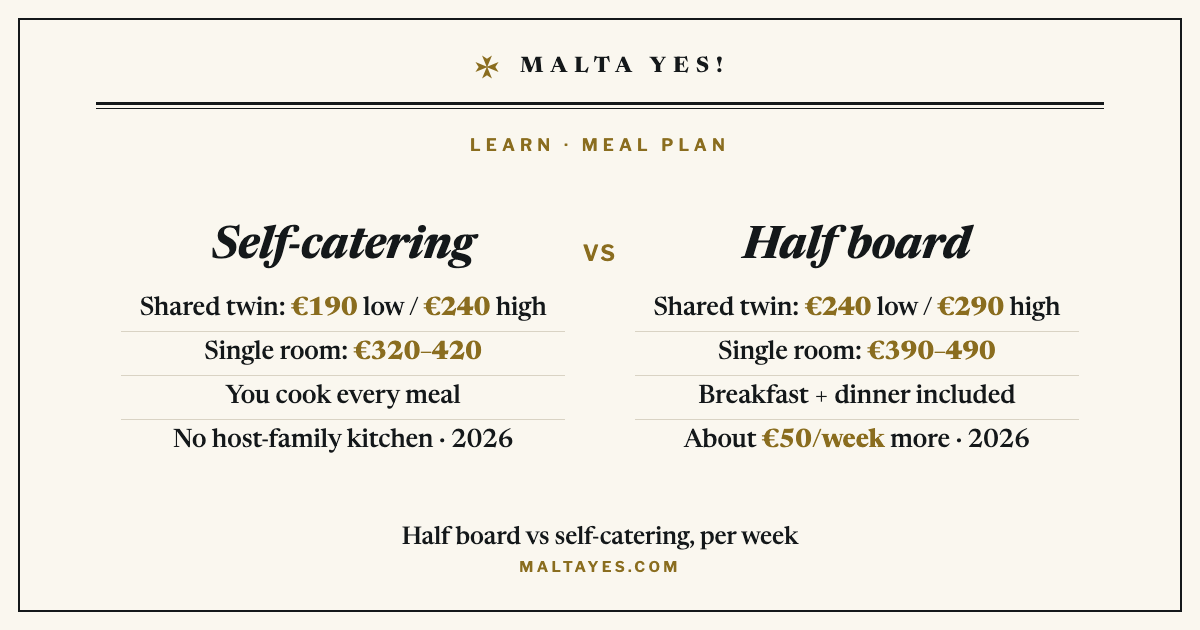
Once you have picked your accommodation type — host family or apartment — the last box to tick is the meal plan: pay extra for half board, or self-cater and cook for yourself? The short answer is that half board costs roughly €50 a week more than self-catering at a Malta English school, and whether that is money well spent comes down to one honest question about how you will actually live day to day. This guide gives you the real euro delta across three schools, what half board does and does not include, and who should pay the premium — and who is throwing money away.
It is the natural next decision after you have chosen your accommodation type: that piece picks the roof over your head, this one picks the food inside it.
Key facts
- Half board costs about €50 a week more than self-catering at ACE English Malta — €240 vs €190 in low season, €290 vs €240 in high season, for a shared twin/triple room. (2026.)
- The dinner is the real charge. Drop from half board to bed-and-breakfast host family and the premium shrinks to €30 a week (€220 vs €190) — so of that €50, only about €20 is the evening meal; the rest is breakfast and the host-family setup.
- In a single room the gap widens to €70 a week (€390 vs €320 low; €490 vs €420 high) at ACE.
- Half board means breakfast plus dinner. At IH Malta that is a continental breakfast and a hot cooked dinner with dessert; full board (a pricier tier) adds a packed lunch. Self-caterers buy and cook every meal themselves.
- Special diets cost extra. A vegetarian, vegan or gluten-free supplement is €35 a week at ACE host families and €70 a week at IH Malta.
- You usually can’t just use the kitchen. ACE’s terms bar cooking in a host family’s kitchen unless agreed in advance — self-catering really means a self-catering apartment, not a room in a family home.
The short answer: what half board actually costs you per week
At ACE English Malta, whose 2026 list is the clearest to read, a shared twin or triple room is €190 a week self-catering and €240 half board in low season, and €240 versus €290 in high season. Either way the premium is a flat €50 a week — about €200 over a four-week stay, or €600 over three months. That is the number to weigh, not a vague “meals cost more”.
Here is the part no school spells out. Half board is breakfast and dinner; drop the dinner and book bed-and-breakfast host family instead, and at ACE the premium over self-catering falls from €50 to €30 a week (€220 vs €190). In other words, only about €20 of your €50 is the evening meal — the other €30 is breakfast and simply being in a host family rather than an apartment. So the real question half board asks is narrow: is a cooked dinner waiting for you each night worth roughly €20 a week?
What “half board” includes — and doesn’t
Half board is a cooked breakfast and a cooked dinner, six or seven days a week, provided where you sleep. The detail varies by school and by accommodation type. At IH Malta, host-family half board specifically means a continental breakfast plus a hot cooked dinner with dessert; the pricier full-board tier adds a packed lunch on top, which matters if your school day runs long and you would otherwise buy lunch out. In a student residence, “half board” is canteen-style catering rather than a family meal — fuel, but not the same cultural experience.
What half board does not include is flexibility. You eat what is cooked, when it is cooked, at the house. If you plan late evenings out, weekend trips to Gozo, or simply do not eat big dinners, you will pay for meals you miss. Self-caterers get none of this — no breakfast, no dinner, no packed lunch — and in exchange buy and cook everything themselves, on their own schedule.
Self-catering: where it saves money, and where it just adds hassle
Self-catering genuinely saves money — but only if you actually cook. The €50 a week you keep can vanish fast if a tiring lesson day ends in takeaway three nights out of five. Be honest about your own habits before you bank the saving.
The friction is real and worth naming. Maltese supermarkets keep shorter hours than many students expect, especially on Sundays and public holidays and in the peak July–August crush; shared-apartment kitchens get busy at dinner time; and shopping in an unfamiliar shop for unfamiliar ingredients is its own small daily tax when you are tired. Our guide to grocery shopping on a long stay covers the practicalities, and if you are missing the flavours of home, Malta does have Japanese and Asian grocery stores that make self-catering feel a lot less foreign.
One thing self-caterers should know: the saving assumes an apartment. You cannot simply move into a host family on the cheap self-catering rate and use their kitchen — ACE’s own terms bar cooking in a host family’s kitchen unless agreed in advance. Self-catering means an actual self-catering apartment; if you want the family, you are into half-board or bed-and-breakfast territory.
Three schools’ numbers side by side
Different schools price accommodation differently, but the direction never changes: half board always costs more. Here is how the three compare for a shared room.
| School | Self-catering | Half board | Weekly premium |
|---|---|---|---|
| ACE (shared twin/triple) | €190 (low) / €240 (high) | €240 (low) / €290 (high) | +€50 |
| EC (varies by room grade) | €170–€285 | €220–€325 | ~€50 |
| IH Malta (priced per night) | €30–€40/night | €35–€50/night | ~€35–€70/wk |
IH Malta prices per night rather than per week, so multiply by seven for a weekly figure — a shared self-catering residence works out around €210–€280 a week against a half-board host family of roughly €245–€350. Single rooms cost more everywhere, and the premium grows with them: at ACE the gap is €70 a week in a single, not €50. One long-stay trap: at ACE the high-season supplement is only waived once a booking reaches 24 weeks or more, so an 8–23 week summer stay still pays it — worth modelling into the total you send the school, and part of what a Malta month really costs once meals are in.
Special diets and the hidden supplement
If you are vegetarian, vegan, gluten-free or have another dietary need, half board carries a supplement that changes the maths. At ACE host families it is €35 a week; at IH Malta it is €70 a week. Over a longer stay that is a real sum on top of the meal-plan premium itself — €70 a week at IH is another €280 a month just to be fed food you can actually eat.
This is where self-catering quietly wins for many people with dietary needs: buying and cooking your own food gives you total control over ingredients, usually for less than the supplement, and removes the nightly worry of whether dinner will suit you. If you self-cater, the special-diet supplement simply does not apply — you are already sorting your own meals.
Who should pay the premium, and who shouldn’t
Pay for half board if: you know you will not reliably cook after a full day of lessons; you are nervous about shopping and cooking with unfamiliar ingredients in an unfamiliar supermarket; your stay is short enough that the hassle of self-catering is not worth the saving; or — the underrated one — you want the nightly host-family dinner as daily English practice. That dinner-table conversation is one of the strongest immersion features a host family offers, and for a lot of students it is worth the €20-a-week dinner charge on its own.
Self-cater if: you enjoy cooking and will genuinely do it; you want control over your budget or a special diet; you are staying long enough that €50 a week (€200 a month) adds up to real money; or you value the freedom to eat when and what you like. The independent, price-conscious learner who is comfortable in a kitchen almost always comes out ahead self-catering — provided they are honest that they will actually shop and cook, not order in.
Frequently asked questions
Is half board worth it at an English school in Malta?
It is worth it if you will not reliably cook for yourself or you want the host-family dinner as English practice; it is not if you enjoy cooking and want to save money. The premium is about €50 a week over self-catering, but only around €20 of that is the dinner itself — the rest is breakfast and being in a host family. For a short stay, or a nervous first-time cook abroad, that convenience is usually money well spent.
What's the difference between half board and full board at a Malta host family?
Half board is two cooked meals a day — breakfast and dinner — provided by your host family or residence. Full board adds a third: a packed lunch to take to school. At IH Malta, for example, half board is a continental breakfast plus a hot dinner with dessert, and full board layers a packed lunch on top for a higher weekly price. If your school day is long and you would otherwise buy lunch out every day, full board can occasionally pay for itself; most students find half board is enough.
Can I cook my own food if I stay with a host family in Malta?
Usually not without asking first. ACE's terms, for instance, specifically bar students from cooking in a host family's kitchen unless it has been agreed with the family in advance. Host-family placements are built around the family cooking for you, not around kitchen access. If cooking for yourself matters to you, book a self-catering apartment instead — that is what the self-catering rate actually buys, and it comes with a kitchen you are free to use.
Is self-catering cheaper than half board in Malta?
On paper, yes — about €50 a week cheaper for a shared room at ACE, and a similar gap at other schools. But the saving is only real if you cook. Factor in takeaways on tired evenings, the special-diet supplement you avoid, and shorter supermarket hours in peak summer, and the true difference narrows for some students and widens for others. If you are disciplined in a kitchen it is clearly cheaper; if you are not, half board can be the better value despite the higher sticker price. ---