
learn
'Paying a Malta English school from Japan: SWIFT fees, Wise/Flywire, and what
Wiring school fees from a Japanese bank? Expect ¥3,000–¥8,500 in fees plus a 1–3% exchange-rate spread. Four of five Malta schools accept Flywire instead. *(154
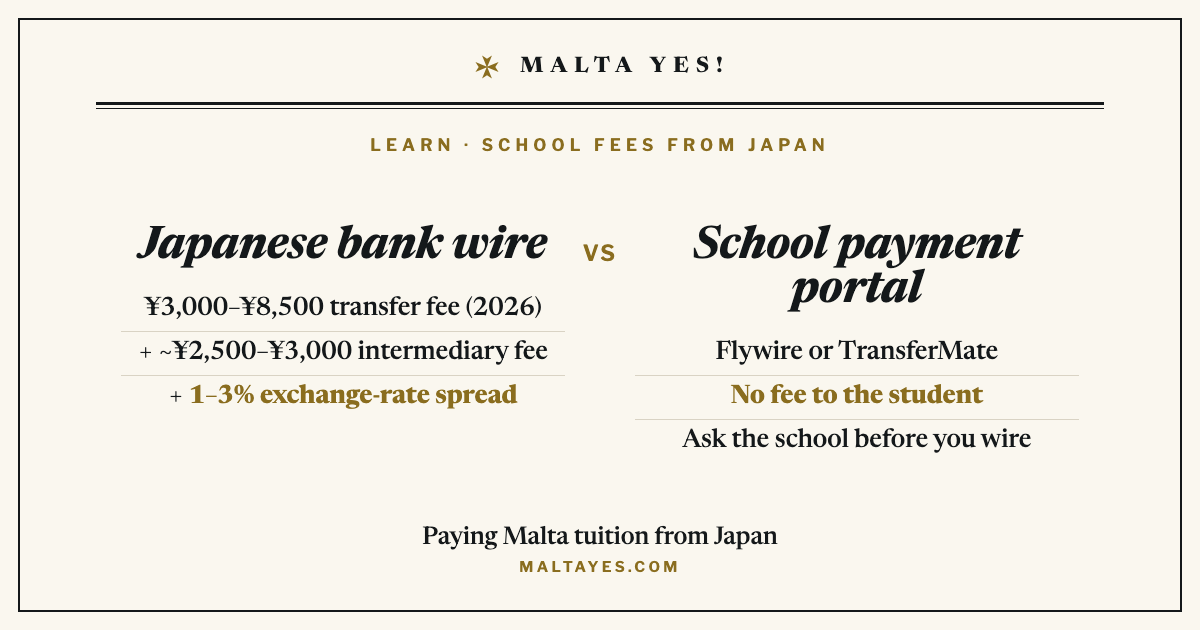
If you are wiring tuition from a Japanese bank to a Malta English school, the transfer itself can quietly cost you 3–5% of the invoice. The advertised bank fee — somewhere between ¥3,000 and ¥8,500 — is only part of it. The rest hides in the exchange rate and in the intermediary banks your money passes through on the way.
Before you send anything, ask your school one question: do you accept Flywire or TransferMate? Several Malta schools now do, and on those rails the student is usually charged no transfer fee at all. If the answer is no, the rest of this guide is about losing as little as possible on a standard wire.
Key facts
- Most Malta schools invoice in euros, and most say some version of “all bank charges to be borne by the client” — meaning any fee deducted along the way is your problem, not theirs.
- A Japanese megabank wire has three costs, not one: the transfer fee (¥3,000–¥8,500), an intermediary-bank fee (around ¥2,500–¥3,000 if you choose to cover all charges), and the bank’s exchange-rate spread — typically 1–3% below the mid-market rate, and never shown as a fee.
- Online beats the counter, every time. Mizuho’s branch-counter transfer is ¥8,000–¥8,500; the same transfer through the Mizuho Direct app is ¥5,000.
- Four Malta schools we checked use a payment portal: Alpha, Gateway (GSE) and inlingua take Flywire; ClubClass uses TransferMate. Maltalingua takes bank transfer only.
- Fees checked July 2026. Bank tariffs change — check your own bank’s current page before you send.
Why “all charges to be borne by the sender” costs more than you think
Domestic 振込 in Japan is simple: you send ¥100,000, the other side receives ¥100,000. An international wire does not work like that.
Your money travels over the SWIFT network, and it may pass through one or two correspondent banks — banks that neither you nor your school chose, sitting between your Japanese bank and the school’s Maltese bank. Each one is entitled to take a handling fee out of the amount in transit.
So when a school’s terms say all charges are yours, they mean: if the money arrives short, you still owe the difference. Schools do chase it. Some will not confirm your place until the invoice is settled in full.
You have two ways to handle this on a normal wire. You can select “OUR” (sender pays all charges), where your bank collects an extra intermediary fee upfront — MUFG charges around ¥3,000 for this — and the school receives the full amount. Or you select “SHA” (shared), which is cheaper for you but means the school may receive less than the invoice. For tuition, OUR is usually the right choice. Paying ¥3,000 to avoid a shortfall dispute is good value.
The four ways to pay
1. A wire from your Japanese bank. The default, and usually the most expensive. Three costs stack: the transfer fee, the intermediary fee, and the exchange-rate spread. That last one is the big one and it is invisible — the bank simply gives you a worse rate than the real one.
2. Wise. Wise charges a small fixed fee plus a variable percentage, and converts at the mid-market rate — the rate you see on Google — rather than a marked-up bank rate. For most people this is meaningfully cheaper than a megabank wire. You will need a Wise account and identity verification before you can send, so set it up a week or two before the deadline, not the night before.
3. Flywire. A payment platform built for education. Your school gives you a link, you enter the invoice amount in euros, and Flywire shows you what to pay in yen. Alpha School of English calls it their “preferred payment method” and says it removes hidden bank fees and uses wholesale exchange rates. Gateway (GSE) runs a Flywire portal; inlingua’s 2026 terms list it as accepted.
4. TransferMate. The same idea, different company. ClubClass uses it, and TransferMate’s education platform advertises paying in your home currency at no cost to the student.
One caution on portals. The platforms’ marketing focuses on the fee — and it is true that the student is usually not charged one. The margin can still sit inside the exchange rate. So compare the yen total the portal quotes you against the euro invoice multiplied by the mid-market rate. If the gap is small, the portal has done well by you. If it is not, a Wise transfer may still win. Two minutes of arithmetic, potentially tens of thousands of yen.
Which Malta school uses which rail
| School | Payment rails found | What their terms say |
|---|---|---|
| Alpha School of English | Flywire (preferred), PayPal, bank transfer, Revolut | Flywire promoted as removing hidden bank fees |
| Gateway School of English (GSE) | Flywire portal, bank transfer | Bank transfer charges “to be incurred by the student” |
| inlingua Malta | Flywire, bank transfer | Flywire listed in the 2026 Terms & Conditions |
| ClubClass | TransferMate, bank transfer | “Pay in your home currency, no cost to the student” |
| Maltalingua | Bank transfer only | “All bank charges to be borne by the client” |
If your school is not in this table, do not assume. Email admissions and ask directly — the wording below does the job.
Japanese bank fees, compared
These are the headline transfer fees as published in 2026. Remember that none of them include the exchange-rate spread.
| Bank | Online transfer | Branch counter | Intermediary fee (sender pays) |
|---|---|---|---|
| MUFG | ¥2,500–¥3,000 | ¥7,000 | ~¥3,000 |
| SMBC | ¥3,000–¥3,500 | ¥7,000–¥7,500 | Check current tariff |
| Mizuho | ¥5,000 (Mizuho Direct) | ¥8,000–¥8,500 | ¥2,500 |
The pattern is the same at all three: use the app, never the counter. Walking into a branch to send money to Malta costs roughly ¥4,000–¥5,000 more than doing the identical thing on your phone.
How to check what your school accepts, before you send a yen
Send this to admissions before you pay anything:
- Do you accept Flywire or TransferMate for this invoice? If so, please send the payment link.
- If I pay by bank transfer, will you accept a payment that arrives short because of intermediary bank fees, or must I cover them?
- Is the deposit refundable if my visa is refused?
That third question is not about transfers, but it is the one people forget to ask. If you are still deciding how you book, our comparison of booking through an agency versus going direct covers who actually handles the money in each case, and our look at school refund and cancellation policies shows how differently schools treat a deposit once it has landed.
The mistakes we see most often
Treating the bank’s fee as the total cost. It is not. Add roughly 1–3% for the exchange rate. On €3,000 of tuition, that spread alone can be worth more than the transfer fee.
Sending from the branch counter. Almost always the most expensive way. The same wire is thousands of yen cheaper in the app.
Choosing “shared charges” on a tuition payment. You save a little, then the school tells you they received €2,965 against a €3,000 invoice and you have to send another wire — paying a second transfer fee to close a €35 gap.
Leaving it until the last week. Wise verification, or getting a Flywire link out of a school’s admissions office in August, takes days. A wire itself can take two to five working days to land.
Paying before you have checked the visa position. If you are non-EU, read our guide to studying in Malta as a non-EU citizen and, for a stay over 90 days, the long-stay (D) visa — the visa often requires proof of payment, which sets the order you do things in. And if you are still weighing up destinations, the money comparison in Malta vs Ireland for studying English is the place to start, before any of this matters.
Once you land, a separate question comes up quickly: whether you need a local bank account at all. Mostly you do not — see do you need a Maltese bank account. And if you have not booked the journey yet, flights from Japan to Malta is the other big number in this budget.
Frequently asked questions
What is the cheapest way to pay a Malta language school from Japan?
Usually a school payment portal, if your school offers one. Alpha, Gateway and inlingua accept Flywire; ClubClass uses TransferMate. Students are typically charged no fee on these rails. If your school takes bank transfer only, Wise is normally cheaper than a megabank wire, because it converts at the mid-market rate instead of a marked-up bank rate.
Does Flywire charge the student anything extra on top of the exchange rate?
Flywire's position, as schools describe it, is that it removes hidden bank fees and uses wholesale exchange rates — so no separate fee falls on the student. What we cannot verify for you is the exact rate you will be quoted on the day. Compare the yen total against the euro invoice at the mid-market rate before you confirm. If the gap looks large, get a Wise quote too.
Which Japanese bank is cheapest for an international transfer?
On published 2026 fees, MUFG's online transfer is the lowest of the three megabanks at ¥2,500–¥3,000, against ¥3,000–¥3,500 at SMBC and ¥5,000 through Mizuho Direct. But the fee is not the whole cost — the exchange-rate spread usually matters more, and it differs by bank and by day. Use the app rather than the counter at any of them.
What if my bank does not cover the intermediary fee and the school receives less than invoiced?
You still owe the difference. Most Malta schools state that all bank charges are the student's responsibility, so a short payment leaves your account unsettled — and some will not confirm your booking until it is. To avoid this, choose the "sender pays all charges" (OUR) option when you set up the wire. It costs around ¥2,500–¥3,000 more and removes the problem entirely. ---