
learn
'Malta vs New Zealand for studying English: the cost gap, and the native-speaker
Malta's tuition starts lower and entry is visa-free, but New Zealand flies nonstop from Tokyo and immerses you in native English. Honest 2026 comparison.
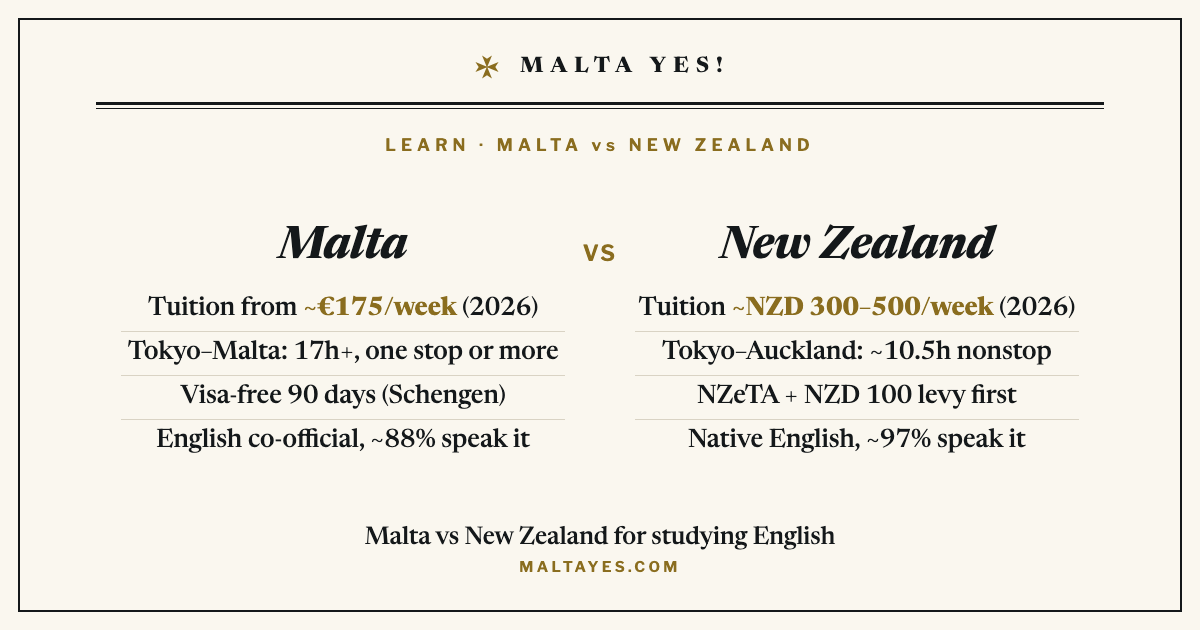
If you are choosing between Malta and New Zealand for an English course, the honest headline is this: Malta is cheaper to start and simpler to enter, while New Zealand gives you a nonstop flight from Tokyo and native-speaker immersion. Almost every part of that is more nuanced than the usual “Malta is far cheaper and closer” pitch, though — so here is the sourced version, with 2026 prices.
Key facts
- Cheapest tuition is Malta’s — but only just. Malta’s budget schools start around €150–175/week in 2026; New Zealand runs roughly NZD 300–500/week (about €150–255). The ranges overlap; Malta’s edge is real only at the bottom.
- Living costs are a genuine toss-up. One index has Malta about 5% cheaper, another has New Zealand cheaper. Treat it as a tie.
- The flight is the surprise. Tokyo to Auckland is a nonstop of about 10h25m; Tokyo to Malta has no direct flight and takes 17h45m or more with at least one stop.
- Entry favours Malta. Malta is visa-free for 90 days (Schengen), with nothing to pre-arrange in 2026; New Zealand needs a paid NZeTA plus a levy before you fly.
- Immersion favours New Zealand. It is about 97% English-speaking and native; Malta is about 88.5%, with English co-official alongside Maltese.
Malta vs New Zealand at a glance
| Malta | New Zealand | |
|---|---|---|
| Tuition, General English | ~€150–175/wk (budget); €180 low / €245 high at IH Malta | ~NZD 300–500/wk (≈€150–255); LSI Auckland “20” from NZD 450 |
| Living cost per month | ~$1,725 (one index) | ~$1,823 (same index) — another flips it |
| Flight from Tokyo | 17h45m+, one stop or more; ¥150k–220k return | ~10h25m nonstop (Air NZ, daily) |
| Short-course entry | Visa-free 90 days (Schengen) | NZeTA + NZD 100 levy (~NZD 117–123) |
| English | Co-official, ~88.5% speak it | Native, ~97.2% |
| Time vs Japan | 7–8 hours behind | ~3 hours ahead |
Course fees: where Malta actually undercuts New Zealand
The rough assumption is that Malta costs half what New Zealand does. It doesn’t, once you convert. At 1 NZD ≈ €0.51 (late July 2026), New Zealand’s typical NZD 300–500/week is about €150–255. Malta’s official mid-tier prices sit right inside that band: IH Malta’s General English (20 lessons) is €180/week in low season and €245 in high summer; EC Malta starts at €174.60. LSI Auckland’s “General 20” is NZD 450, about €229. The mid-tiers overlap almost exactly.
Where Malta genuinely wins is at the budget end, where you can find General English around €150–175/week (roughly ¥28,000–33,000) — cheaper than almost anything in New Zealand. Intensive courses, by contrast, are level: Maltalingua’s 30-lesson crash course is from €267.72/week, and LSI’s Intensive 30 is NZD 527 (about €268). So the honest line is that Malta is the cheaper option only if you shop at its budget tier; in the mid-market the two are the same money. For how this looks against other destinations, see Malta vs Ireland and Malta vs the UK.
Living costs: a toss-up, not a Malta walkover
Two respected indexes disagree here — on direction, not just size. livingcost.org (June 2026) puts Malta at about $1,725 a month against New Zealand’s $1,823, so Malta about 5% cheaper, with near-identical rent but far cheaper local transport in Malta ($58 against $141 a month). Numbeo (July 2026), once converted, points the other way: Malta about €1,680 against New Zealand’s €1,394, which makes New Zealand look cheaper overall.
When two serious sources flip the result, the honest read is a tie. The durable, non-obvious point is small-island transport economics: Malta’s buses are cheap and everything is close, so a student’s monthly transport bill really is low. Don’t choose on a headline “X% cheaper” figure here — it sits inside the noise.
Getting there from Japan: New Zealand’s surprising edge
This is where the usual pitch is simply wrong. There is no direct flight from Japan to Malta: the fastest routings run about 17 hours 45 minutes with at least one stop, through a European or Gulf hub, and return fares are typically ¥150,000–220,000. Tokyo to Auckland, by contrast, is a nonstop Air New Zealand flight of about 10 hours 25 minutes, daily.
So on the journey itself, New Zealand is arguably the easier trip, not Malta. For the Malta routing spelled out, see flights from Japan to Malta. One more point, for family back home: Malta is 7–8 hours behind Japan, while New Zealand is about 3 hours ahead, so calls home are easier from New Zealand.
Visa and entry: 90 free days, or a levy before you fly
For a short course, Malta is the simpler entry by far. A Japanese passport holder enters Malta, and the Schengen area, visa-free for 90 days in any 180, with nothing to pay or arrange in advance. The EU’s ETIAS pre-travel authorisation has been delayed again and is now expected in 2027 at the earliest, so that free entry still holds today. A course longer than 90 days needs a Maltese national (D-type) visa — see the 90-day line and the long-stay student visa.
New Zealand works differently. A course under three months needs no student visa for a Japanese citizen, but you must buy an NZeTA before travel (NZD $17 via the app, $23 online) and pay the NZD $100 International Visitor Levy alongside it — about NZD 117–123, roughly ¥11,000, in total. A course of three months or more needs a full student visa: an offer of a place, proof of funds, and processing that can take eight weeks or more. New Zealand asks student-visa applicants to show about NZD 1,667 a month in living funds, and a realistic Auckland or Wellington budget is NZD 1,800–2,250 a month.
The real trade-off: EU immersion, or native English
Here is the honest heart of it — the same trade-off we draw in every comparison. New Zealand is a native-English country: about 97% of people speak English, and outside class you are surrounded by it around the clock. Malta is about 88.5% English-speaking, with English co-official alongside Maltese. That is excellent for daily life, signage and study, but you will hear Maltese around you, and your classmates will be a European mix.
If your single goal is the maximum of native-speaker exposure, New Zealand wins that cleanly. Malta’s counter-offer is everything wrapped around the English: cheap entry, EU proximity, a large regulated school market, and a Mediterranean base near the rest of Europe. Whether Malta’s English holds up in daily life is a fair question, and for study the answer is yes — but “native, 24 hours a day” genuinely belongs to New Zealand.
Which one fits you
Choose Malta if your budget is tight and you want the cheapest start, if you value visa-free entry and the freedom to travel around Europe between lessons, or if a short, spontaneous trip suits you. Choose New Zealand if native-speaker immersion is the entire point, if a single nonstop flight matters to you more than saving money, or if you are going for three months or more and don’t mind the visa process.
On cost, the two are closer than you have been told. On the journey, New Zealand is easier. On immersion, New Zealand is purer. On entry and flexibility, Malta wins. Match those four to what you actually want, and the choice makes itself.
Frequently asked questions
How much does it cost to study English in Malta for one month?
Budget roughly €600–1,000 for four weeks of tuition, depending on the school and season: budget schools start around €150–175/week, while a mid-tier school like IH Malta is €180/week in low season and €245 in high summer. Add living costs of roughly €1,500–1,700 a month. So a modest month, tuition plus living, lands somewhere around €2,100–2,700 (about ¥390,000–500,000), before flights.
Do Japanese citizens need a visa to study English in New Zealand?
For a course under three months, there is no student visa — but you must buy an NZeTA before you fly (NZD $17 via the app, $23 online) and pay the NZD $100 International Visitor Levy, about NZD 117–123 in total. For a course of three months or more, you need a full student visa: an offer of a place, proof of about NZD 1,667 a month in funds, and processing that can take eight weeks or more, so start early.
Is Malta's English good enough compared with a native-speaker country like New Zealand?
For studying English, yes. English is co-official in Malta and used in schooling, government and daily life, and about 88.5% of people speak it. New Zealand is a native-English country at about 97%, so it offers purer round-the-clock immersion. The everyday difference is your classmates and the street: in Malta you will hear Maltese and study beside other Europeans; in New Zealand you are among native speakers. Both teach English well; the immersion is deeper in New Zealand.
How long is the flight from Japan to Malta compared with New Zealand?
Very different. There is no direct flight from Japan to Malta; the quickest routes take about 17 hours 45 minutes with at least one stop, and return fares run roughly ¥150,000–220,000. Tokyo to Auckland is a nonstop Air New Zealand flight of about 10 hours 25 minutes, daily. So despite New Zealand feeling "further", it is actually the shorter and simpler journey from Japan. ---