
live
Bringing your dog or cat to Malta for a long stay: the pet passport process, and the timing traps
Work back from your flight: microchip first, then the rabies jab, then 21 days. Dogs need tapeworm treatment 24–120 hours before landing — cats do not.
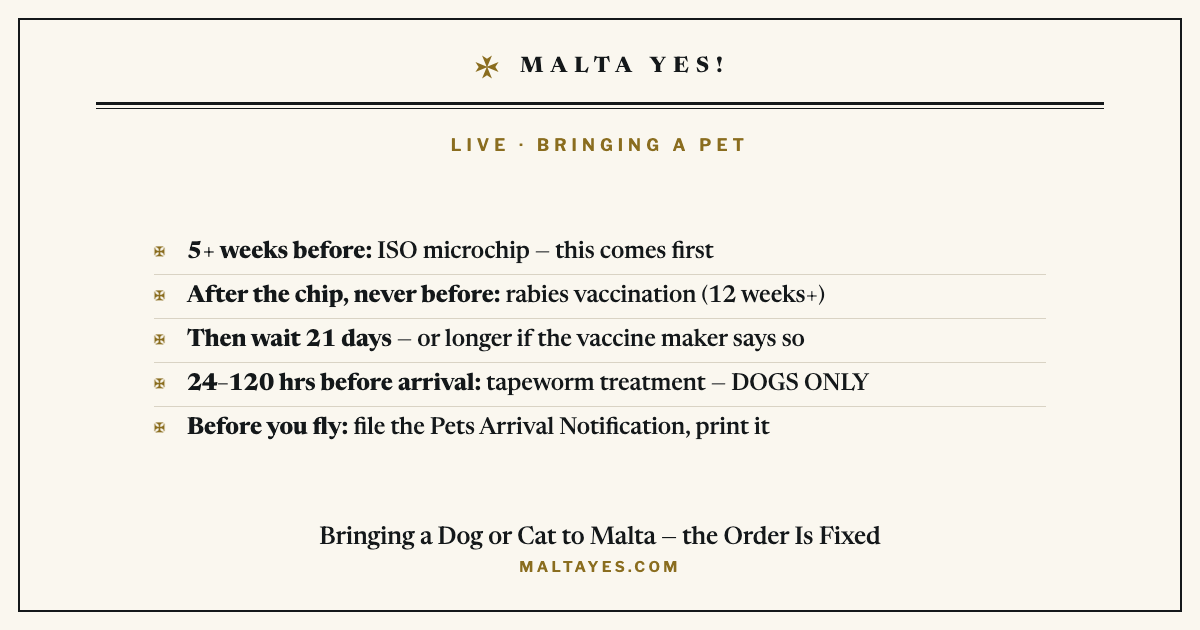
Malta’s pet rules are not complicated. They are strictly ordered, and the first step falls about five weeks before you fly. Microchip, then rabies vaccine, then a 21-day wait. Then, for dogs only, a tapeworm treatment inside a 24-to-120-hour window before landing, and an arrival notification filed online before you leave. Get the order wrong and there is usually no paperwork fix. You start again.
This is for a long stay, not a move: a few weeks or months, there and back again.
Key facts
- Allow five weeks minimum from an EU or “listed” country. Microchip, then vaccine, then 21 days.
- The microchip goes in first. A rabies vaccination given before the chip does not count and must be repeated.
- 21 days is a floor, not the rule. Some vaccine makers specify 30 days, and the maker’s period wins.
- Tapeworm treatment: dogs only, 24–120 hours before arrival. Cats and ferrets are exempt. Malta is one of only four places in Europe that require it.
- The Pets Arrival Notification is filed online before you travel. servizz.gov.mt puts it plainly: “if not fulfilled the pets’ entry to Malta will be denied.”
- Japan, the UK, the US and Australia are all on the EU list — no blood test, just the 21 days.
- There is no blanket quarantine. A compliant pet walks out of the airport with you.
The timeline, worked backward from your flight
| How far ahead | Step | Who it applies to |
|---|---|---|
| 5 weeks or more | ISO-compliant 15-digit microchip implanted | Dogs, cats, ferrets |
| Same day or after — never before | Primary rabies vaccination, pet aged 12 weeks or older | All |
| 21 days after that vaccination | The earliest date your pet may enter Malta | All |
| Within 10 days of arrival | Official veterinary health certificate issued and endorsed | Non-EU only |
| 24–120 hours before arrival | Tapeworm treatment, recorded by the vet as it is given | Dogs only |
| Before you leave | Pets Arrival Notification filed online, copy printed | All |
Five weeks is the floor, not a target. Vets need appointments, and the tapeworm window is five days wide and may land on a Sunday. Six to eight weeks is comfortable. Under five is a gamble.
Microchip, then vaccine, then 21 days
The order is the whole thing. Your vet implants an ISO-compliant microchip — 15 digits, standards ISO 11784 and 11785 — and must scan it before giving the rabies vaccination. A vaccination given to an unchipped animal is not late paperwork. As far as the EU is concerned it did not happen, and it must be given again.
The wait after that vaccination is where most guides are slightly wrong. The rule is at least 21 days or the immunity period the vaccine manufacturer specifies, whichever is longer. Some say 30. Ask your vet which vaccine they are using and have them write the validity dates on the certificate, because your pet cannot enter before the “valid from” date.
One more distinction matters on a long stay. The first vaccination after microchipping is a primary, and it triggers the wait. A booster given before the previous one expires does not, so your pet can travel immediately. But if cover lapses even by a single day, the next shot counts as a primary again and the 21 days restart. If the vaccine expires while you are in Malta, get the booster before it lapses. Letting it run out is the expensive mistake, and the one nobody sees coming.
A puppy or kitten cannot be vaccinated before 12 weeks, making 15 weeks the earliest realistic travel age.
The tapeworm window: dogs only, and Malta is one of only four
This step catches people because it barely exists anywhere else. Four places in Europe require treatment against the tapeworm Echinococcus multilocularis before a dog arrives: Finland, Malta, Ireland (including Northern Ireland) and Norway. They are free of the parasite and intend to stay that way.
Three things to get right:
- Dogs only. Cats and ferrets are not subject to it. Bringing a cat? This section does not apply to you at all.
- 24 to 120 hours before your scheduled arrival. Not before departure — before arrival. A vet in your departure country does it, and signs it into the passport at the moment of treatment, not in advance.
- The medicine must be labelled for E. multilocularis. Praziquantel is the usual active ingredient. A general worming tablet is not the same thing.
A dog travelling directly from Finland, Ireland, Northern Ireland or Norway is exempt. Everyone else needs it, including dogs from elsewhere in the EU.
The form that gets pets refused entry
The Pets Arrival Notification is an online form, reached through servizz.gov.mt and submitted on the nldmalta.gov.mt portal. It is the cheapest step and the one with the sharpest consequence. servizz.gov.mt says it without softening: “if not fulfilled the pets’ entry to Malta will be denied.”
Print it. The page tells you to carry a copy during the journey, and airline staff may ask before they let the animal board.
No deadline is published, which is unhelpful when the penalty is refusal. What the page does give is the service’s own timeline: four stages, one day each — vetting, assessment, approval, delivery. Read that as your answer. File about a week ahead. The night before is not a plan.
If you are coming from outside the EU’s list
The EU keeps a list of countries whose pets skip the blood test, and it is longer than people expect: Japan, the United States, the United Kingdom, Australia, Canada, Switzerland, Singapore and about forty more. If you are on it, the 21 days is your whole wait.
If your country is not on it, the route is much longer and the order is again unforgiving:
- Microchip, then rabies vaccination.
- A blood sample drawn at least 30 days after the vaccination, tested for rabies antibodies. The result must be 0.5 IU/ml or higher.
- Three months’ wait from the date the blood was drawn — not from the vaccination, and not from the test result. This is the step people misread, and it costs them three months.
So an unlisted country means roughly four months, not five weeks.
One note on the paperwork: the lists were renumbered this year. Regulation (EU) 576/2013 is still the parent law, but the country lists now sit in Delegated Regulation (EU) 2026/131, in force since 22 April 2026. If a page you are reading cites Regulation 577/2013, it is out of date. New certificate models are due on 1 October 2026 according to USDA APHIS, but Malta has published nothing on that point, so ask your vet which form is current.
If something is missing when you land
There is no routine quarantine. A compliant cat or dog is examined and leaves with you.
If a document is missing, servizz.gov.mt describes two outcomes, and neither is a fine: “the pet will either have to go back to the country of departure or detained in quarantine.” Quarantine runs until the problem is fixed — and if the gap is a missing rabies vaccination, “fixed” means the vaccine plus the 21 days, with your dog boarding at your expense throughout. That is the real cost here. Not a penalty. A bill that runs by the day while a clock you already had to wait out runs again.
About the €3,700 fine you may have read about. It circulates widely, from one expat blog. We looked for it in Maltese law and could not find it: pet import sits under the Veterinary Services Act (Cap. 437), whose penalties do not produce that figure. We are not repeating a number we cannot source. What is documented is refusal or quarantine at your expense — reason enough to file the form.
Two things while you plan. Maltese vets work in English, so the paperwork here is as straightforward as everything else — but confirm your accommodation takes animals before booking, which matters if you are weighing a host family against an apartment. And from Japan there is no direct route, so each connection stacks another airline’s pet policy on Malta’s: see the options.
Frequently asked questions
How long before travelling does my dog need its rabies vaccine for Malta?
At least 21 days before arrival, and the microchip must already be in place. Check the vaccine's own immunity period, because some manufacturers specify 30 days and the longer period wins. A booster given before the previous vaccination expires needs no wait at all.
Does my pet have to go into quarantine in Malta?
No, not if the paperwork is right. Malta has no routine quarantine for compliant cats and dogs. Quarantine only follows a failed requirement: servizz.gov.mt says an animal that does not meet the rules is either returned to the country of departure or detained, at your expense, until the problem is fixed.
What is the tapeworm treatment window for dogs entering Malta?
Between 24 and 120 hours before your scheduled arrival, so one to five days. Dogs only. The treatment must target *Echinococcus multilocularis*, and the vet records it as it is given. Malta is one of only four places in Europe requiring it, alongside Finland, Ireland and Norway.
Is Japan a "listed" country for EU pet travel rules?
Yes. Japan appears on the European Commission's current list, under Delegated Regulation (EU) 2026/131. So a pet travelling from Japan to Malta needs no rabies antibody blood test and no three-month wait. The standard route applies: microchip, rabies vaccination, 21 days, health certificate. ---