
live
Why St Paul's Bay is popular with expats — and who should (and shouldn't) live
St Paul's Bay is Malta's biggest town and 63% non-Maltese, with two-bed flats from €1,000 — well under Sliema. Who should live here, and who shouldn't.
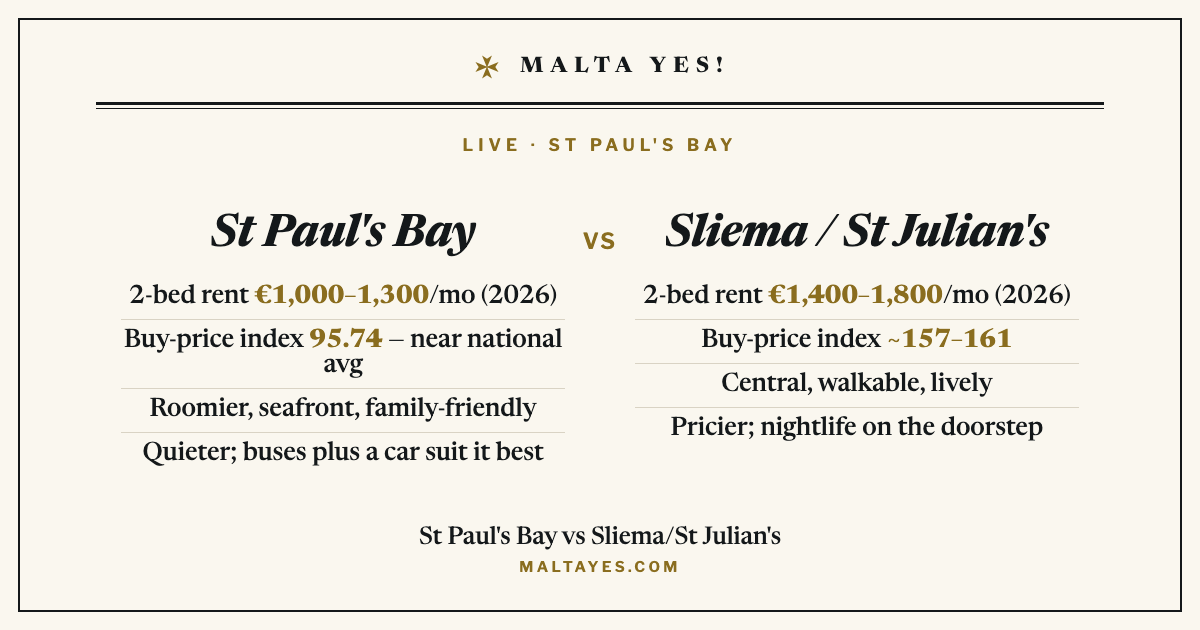
St Paul’s Bay is the cheaper, roomier and more family-minded side of expat Malta: the island’s largest town, where most residents are foreign, rents sit well below Sliema, and the sea is never far. We live here, and the honest version is that it suits families, retirees and budget-conscious long-stayers far more than anyone chasing nightlife or a short walk to the office. Here is why expats cluster along the St Paul’s Bay–Bugibba–Qawra coast, what it costs, and who should think twice before signing a lease.
Key facts
- Malta’s biggest locality. St Paul’s Bay — which takes in Bugibba, Qawra, Xemxija and Burmarrad — had 40,204 residents at the end of 2024, more than anywhere else on the island.
- A majority-foreign town. About 63% of residents are non-Maltese (roughly 25,244 people) against 14,960 Maltese, making it one of only six Malta localities where foreigners outnumber locals.
- Cheaper than the east coast. A two-bedroom flat rents for about €1,000–1,300 a month here, against €1,400–1,800 in Sliema or St Julian’s (Frank Salt, 2026). To buy, the area’s price index is 95.74 (near the national average) versus roughly 157–161 for those two towns.
- A good bus spine — better with a car. Direct buses reach Valletta (routes 31, 45, 48 and TD13) and the airport (TD1) with no change in Valletta; crossing to the other side of the island is slower.
- The Bugibba Square works are finished. The square’s €10 million regeneration, a disruptive building site through 2025, was completed and reopened in May 2026.
- International schools are a short drive inland. QSI in Mosta and Verdala in Pembroke are roughly a 15–25 minute drive, depending on traffic.
Why expats cluster in St Paul’s Bay, Bugibba and Qawra
The short answer is space and sea air for less money. A family priced into a cramped two-bed in Sliema can rent a larger flat here, often with a balcony and a view, and still walk to the water. That trade — more room, lower rent, a slower pace — has drawn foreign residents north for decades.
The international character is not new. St Paul’s Bay grew into a tourist and expat centre from the 1960s, as Malta built up seaside tourism after independence in 1964 and Britain wound down its naval presence; the Bugibba and Qawra bar strips followed. What began as a British holiday and retirement coast is now broadly international, with Italians a large and growing presence — helped by EU freedom of movement, cheap flights and weekend-close Sicily. The trend is clear: 63% of the locality is now non-Maltese, up from 54% in 2021.
It is not a cut-off enclave, though: a working town with schools, health centres and a year-round rhythm that thins in winter but never empties.
What it actually costs: rent versus Sliema and St Julian’s
Cost is the main reason people choose this coast, and the gap is real — clearest on the larger flats.
| Monthly rent / to buy | St Paul’s Bay–Bugibba–Qawra | Sliema / St Julian’s |
|---|---|---|
| One-bedroom flat (rent) | from about €1,000 | €1,000–1,300 |
| Two-bedroom flat (rent) | €1,000–1,300 | €1,400–1,800 |
| Apartment price to buy (NSO index) | 95.74 (near national average) | about 157–161 |
On a one-bed the difference is modest, but on a family-sized two- or three-bed it is the gap between comfortable and stretched. Buying is starker still: the National Statistics Office’s 2025 price index puts St Paul’s Bay at 95.74, near the national average, against 157–161 for Sliema and St Julian’s — very roughly two-thirds more per square metre. If budget is the deciding factor, the north stretches furthest.
Daily life: buses, driving and amenities
Day to day, St Paul’s Bay is easy in the ways that matter and slow in one that might. The bus spine to Valletta is genuinely good: routes 31, 45, 48 and the TD13 run direct to the capital, and the TD1 goes straight to the airport, with no change in Valletta. For commuting into the capital, or a car-free life, that spine does most of the work. The catch is everything off it: crossing the island, or reaching somewhere the direct routes miss, can mean a long trip with a change, and the traffic is heavy at peak times. Many residents keep a car for exactly that reason, and whether you need one is worth thinking through before you arrive — we cover it in do you need a car in Malta?.
For everyday needs the area is well served: full-size supermarkets, pharmacies, banks, a seafront promenade that runs for kilometres, and plenty of good restaurants. The heart of Bugibba is its main square, which has just come through a long, disruptive €10 million regeneration — water and power cuts, closed pavements, lost footfall — completed and reopened in May 2026. It is now a renewed pedestrian plaza with open sea views, not the building site it was through 2025; our Bugibba Square guide covers what the new space is like to visit.
Bugibba, Qawra or St Paul’s Bay proper: picking your patch
“St Paul’s Bay” is really several places with different characters, and the one you pick matters more than the postcode suggests.
Bugibba is the busy, touristy heart — the most rental supply, the liveliest bars and restaurants, the newly regenerated square, and the most summer crowds. It suits people who want life on the doorstep. Qawra, just around the headland, is calmer and more residential, with the same seafront convenience. St Paul’s Bay proper — the older core around the bay — and Xemxija, climbing the hillside to the west, are quieter and more settled: more neighbourhood, less resort, and often a bit more space for the money. As a rough rule: Bugibba for buzz, Qawra for a middle path, St Paul’s Bay and Xemxija for quiet.
Who should live here
This coast rewards some people and frustrates others. It suits you if:
- You have a family. More space per euro, a safe seafront, and the nearest international schools — QSI in Mosta and Verdala in Pembroke — a 15-to-25-minute drive away.
- You are retiring or slowing down. A long-established, largely British retiree community, an easy pace, and familiar shops and services.
- Budget is the deciding factor. The rent and purchase gap versus Sliema is the biggest single lever over your Malta cost of living.
- You want a real neighbourhood. This is a year-round town where people actually live, not a transient expat enclave.
- You are an EU citizen after sun and sea without London or Milan prices. For Italians especially, freedom of movement and weekend-close Sicily (an easy day trip or overnight) make it a natural base.
Who shouldn’t
Be honest with yourself, though. Look elsewhere if:
- You want nightlife and a walkable scene. The bars, restaurants and cultural life of Sliema, St Julian’s and Valletta are a bus ride away, not a stroll. If going out is central to your week, live closer to it.
- You will work in Sliema, St Julian’s or Gżira. The Valletta bus spine is strong, but a daily cross-coast commute in Malta traffic gets old fast, and the rent saving can be eaten by the time cost.
- You want city buzz for a short, social stint. St Paul’s Bay is calmer and residential, and quietens in winter. A short-stay visitor is usually happier in the east-coast towns.
- You depend on a big Asian or Japanese community and its shops. These are thin this far north; Sliema has far more, and specialist groceries here mean a trip.
- You refuse to use buses and won’t run a car. Life here works best with one or the other; without either, the quieter areas can feel cut off.
Getting set up
If the north suits you, the practical steps are the same as anywhere in Malta but worth getting right early. Sort your flat first — a short let while you learn the sub-areas is sensible before committing to a year, and our guide to renting a flat for a month or three walks through it. Then the everyday admin: getting online matters more than people expect when you are working or job-hunting, and arranging internet and Wi-Fi for a long stay is rarely as instant as at home. Decide the car question early too, as it shapes which sub-area works for you. Get those three right — flat, connection, transport — and St Paul’s Bay is one of the easiest places in Malta to land.
Frequently asked questions
Is St Paul's Bay a good place to live in Malta?
For the right person, yes. It is Malta's largest town, majority-foreign and used to newcomers, with lower rents than the east coast, a walkable seafront and direct buses to Valletta. It suits families, retirees and budget-minded long-stayers especially well. It is a weaker choice if you want nightlife on your doorstep or a short commute into Sliema or St Julian's.
Is it better to live in Bugibba or Sliema?
It depends on what you are optimising for. Bugibba, within St Paul's Bay, is cheaper, roomier and more family-oriented, with a newly regenerated square and a quieter winter. Sliema is pricier but central, walkable and lively year-round, closer to offices, shops and nightlife. Choose Bugibba for space and value, Sliema for buzz and a short commute.
How much is rent in St Paul's Bay?
As of 2026, a one-bedroom flat starts at around €1,000 a month and a two-bedroom runs about €1,000–1,300, against €1,400–1,800 for an equivalent two-bed in Sliema or St Julian's (Frank Salt, 2026). The gap is widest on the larger, family-sized flats, which is the main financial reason people choose the north over the east coast.
Do you need a car if you live in St Paul's Bay?
Not strictly. Direct buses reach Valletta and the airport without a change, so a car-free life is workable, especially if you commute into the capital. But crossing the island by bus is slow, and many keep a car for trips off the main routes and the school run. If your daily life ranges beyond the Valletta line, a car earns its keep. ---