
explore
Learn to sail in Malta: the RYA course pathway (and is a weekend worth it on a study trip?)
Learn to sail in Malta via the RYA ladder: a 2-day Start Yachting taster from ~€450 up to Day Skipper. Which course suits you, and is a weekend worth it?
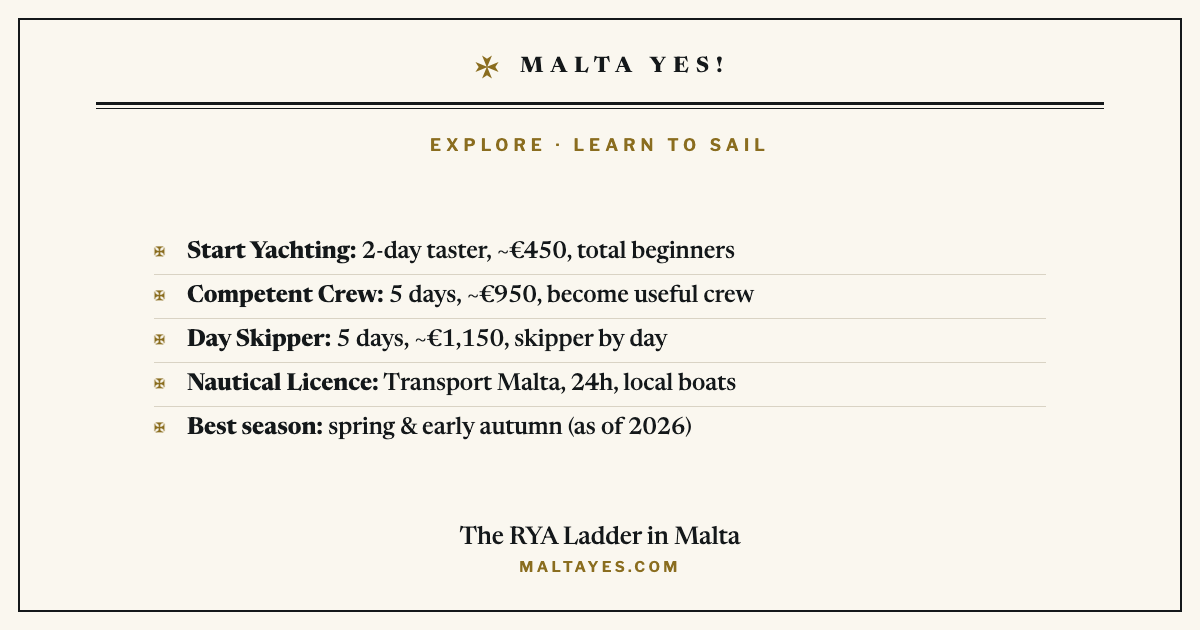
If you want to learn to sail in Malta, the honest short answer is this: yes, it is one of the better places in the Mediterranean to start, and the entry course takes only a weekend. Malta has warm, mostly settled water, a long season, and several schools that teach the internationally recognised RYA ladder — from a two-day taster right up to skipper level. This guide explains each rung of that ladder, roughly what it costs in 2026, who each course suits, and whether it is worth squeezing one in if you are here mainly to study English.
We are writing this as residents, not as a school. The web is full of course pages that all say “book now”. What is harder to find is a plain comparison of the steps, so that is what this is.
Key facts
- RYA stands for the Royal Yachting Association. Its certificates are recognised worldwide, which is why Maltese schools teach them.
- The beginner course, Start Yachting, runs over two days — it fits a single weekend.
- Malta’s sailing season runs roughly April to October, with spring and early autumn giving the steadiest winds for learning.
- A separate, local qualification — the Transport Malta Nautical Licence — lets you drive small boats in Maltese waters. It is not the same as an RYA sailing course.
- Prices below are 2026 figures from Malta schools and shift by season and provider. Treat them as a guide, not a quote. [VERIFY]
The RYA ladder, rung by rung
The RYA system is a staircase. You do not have to climb all of it — most people who just want to enjoy being on a yacht stop after the first or second course.
Start Yachting (2 days). This is the true beginner course, made for people who have never sailed. Over a weekend you learn the very basics: the parts of the boat, simple rope work, how the sails move the yacht, and how to be useful and safe on board. In Malta this runs about €450 per person as of 2026. [VERIFY] It is a taster, not a licence — but it is the single best way to find out whether sailing is for you before spending more.
Competent Crew (5 days). The next step turns a passenger into a genuinely useful crew member. Over five days you handle sails, steer, help with mooring and anchoring, and live aboard the yacht, which is part of the learning. Malta pricing is around €950, typically including onboard accommodation, some meals, fuel and mooring. [VERIFY] If you have already done Start Yachting, some schools let you fast-track this in fewer days.
Day Skipper (5 days practical). This is where you learn to run the boat yourself on short coastal trips — navigation, passage planning, pilotage, boat handling and seamanship. In Malta the practical week costs roughly €1,150 per person. [VERIFY] It is not a beginner course: schools expect you to arrive with real sailing experience (a common benchmark is five days, 100 miles and four hours of night sailing) and with the Day Skipper shorebased theory already learned, because the practical week moves quickly. Several Malta schools sell a fast-track package — Competent Crew, Day Skipper theory, Day Skipper practical and a marine radio course over about three weeks — for around €2,457. [VERIFY]
Yachtmaster (preparation and exam). The top of the ladder, for people heading towards professional or serious cruising standards. It is a preparation-and-exam course rather than a place to begin. If you are asking “is a weekend worth it”, this is not your rung yet.
RYA courses at a glance
| Course | Length | Rough 2026 cost | Who it suits |
|---|---|---|---|
| Start Yachting | 2 days | ~€450 | Total beginners, a weekend taster |
| Competent Crew | 5 days | ~€950 | Want to be useful crew, live aboard |
| Day Skipper (practical) | 5 days | ~€1,150 | Ready to skipper by day; needs prior experience + theory |
| Fast-track package | ~3 weeks | ~€2,457 | Beginner to Day Skipper in one block |
All prices [VERIFY] — 2026, single-school figures that move with season and provider.
The other option: the Transport Malta Nautical Licence
If your goal is simply to drive a small motorboat while you are on the island — not to sail a yacht — the RYA ladder is the wrong staircase. What you want is the local Nautical Licence issued by Transport Malta. The course is a minimum of 24 hours of classroom and practical training, usually spread over about six days. You must be 18, and you need a medical fitness certificate from a doctor before you start. After an oral and practical exam, the licence lets you handle a vessel under 24 metres for pleasure within Maltese territorial waters. You then have twelve months to apply for the licence itself. [VERIFY]
It is worth knowing this exists, because a lot of visitors say “I want to learn to sail” when what they actually mean is “I want to take a small boat out to a quiet bay”. Those are two different courses.
When to do it: Malta’s sailing weather
You can sail in Malta almost all year, but the learning is easier in some months than others. Spring, from about March to June, is the busy training season: mild temperatures and steady, predictable winds are ideal for certification courses. Summer, from July to September, brings hot, sunny days, calm seas and a reliable afternoon breeze (the Maestral, from the north-west) — pleasant for combining a course with a holiday, though the lightest winds mean gentler sailing. May, June, September and October are widely rated the sweet spot. If you are choosing dates for a trip anyway, our guide to the best months to visit Malta lines up well with the good sailing.
The playground itself is a genuine draw. From the marinas you can point the boat towards Gozo and Comino and be somewhere beautiful within hours — the same water you would cross on the Gozo ferry, and the coast around the quiet side of Comino that most day trippers never see.
So — is it worth a weekend on a study trip?
Here is our honest verdict. If you are in Malta to study English and you have a free weekend, Start Yachting is a genuinely good use of two days. It is short, it is a real internationally recognised certificate, and it gets you out on the water doing something most language-school classmates will not. Think of it the way you might think of beginner wreck diving: a proper skill, learned properly, that also happens to be a brilliant day out.
What we would not do is try to reach Day Skipper on a short trip. That course assumes prior sailing and theory, so slotting it into a study visit means arriving under-prepared and rushing. If sailing grabs you during Start Yachting, come back for Competent Crew when you have the time — it is the step where it stops being a taster and starts being a skill.
One practical point for anyone weighing time and money on a language trip: sailing is a treat, not a substitute for class hours. If you are still deciding how long your course should be in the first place, read how many weeks of study you actually need before you start booking sailing days around it.
How to pick a school
Whichever course you choose, the school matters more than the marina. Look for three things: it must be RYA-recognised (for the RYA courses) or Transport Malta approved (for the licence); the group must be small, so you get real time at the helm rather than watching from the rail; and the school should be clear about what is included — accommodation, meals, fuel and certificate fees are sometimes in the price and sometimes not. A cheaper headline course with extras bolted on can end up dearer than an all-in one.
Frequently asked questions
Can a complete beginner learn to sail in Malta?
Yes. The RYA Start Yachting course is designed for people who have never been on a yacht, and it runs over two days. You learn the basics of how a boat works, simple rope handling, and how to be safe and useful on board. It is the standard first step and needs no experience at all — just a reasonable level of fitness and a willingness to get a little wet.
How much does it cost to learn to sail in Malta?
As a 2026 guide, a two-day Start Yachting taster is around €450 per person, a five-day Competent Crew course about €950 (often with accommodation aboard), and a five-day Day Skipper practical roughly €1,150. Prices vary by school and season, and some include meals, fuel and mooring while others do not, so always confirm what is in the figure before booking.
Do I need a licence to sail in Malta?
To take an RYA training course, no — you learn as you go. If you want to drive a small motorboat yourself in Maltese waters, you need the Transport Malta Nautical Licence, which involves at least 24 hours of training, a medical certificate, and an exam. RYA certificates and the local licence are different things, so match the course to what you actually want to do on the water.
When is the best time of year to learn to sail in Malta?
Spring (March to June) and early autumn (September to October) give the steadiest, most predictable winds, which makes learning easier and is why these are the busiest course months. Summer is hot and calm with lighter afternoon breezes — comfortable and good for combining a course with a holiday, but gentler sailing. Winter courses run too, but conditions are less reliable.
Is a sailing course worth doing on a language-study trip?
A two-day Start Yachting course is well worth a spare weekend: it is short, it is a recognised certificate, and it gets you on the water. Longer courses like Day Skipper are not ideal to rush into on a study trip, because they assume prior experience and theory. Treat sailing as a memorable extra alongside your studies, not a replacement for class time. ### SEO fields - **Meta title:** Learn to Sail in Malta: The RYA Course Pathway (2026) - **Meta description:** Learn to sail in Malta via the RYA ladder: a 2-day Start Yachting taster from ~€450 up to Day Skipper. Which course suits you, and is a weekend worth it? - Image slots in body: one Tier-2 facts card (hero), rendered at publish.