
explore
'Loggerhead turtles are nesting on Malta''s beaches: where, when, and how to
Loggerhead turtles nest on Malta's beaches from June, hatching about 50 days later. Where to look, how to watch responsibly, and the €500+ per-egg rule.
If you are on a Maltese beach this summer and come across a small patch of sand fenced off, signposted and taped at the corners, you have almost certainly found a loggerhead turtle nest — and the right thing to do is keep your distance and leave it be. Loggerheads (Caretta caretta, in Maltese il-fekruna komuni) began nesting on Malta’s beaches again only recently, with systematic monitoring in place since 2020, and the season runs from around June, with eggs hatching roughly 50 days later through the summer. This guide explains what you are looking at, when and where it happens, how to see it without doing harm, and exactly who to call if you find a turtle or a nest yourself.
If you already know sea-turtle nesting from a beach back home — many visitors do — Malta’s version will feel familiar, and the rules about light and distance are the same ones conservationists use everywhere.
Key facts
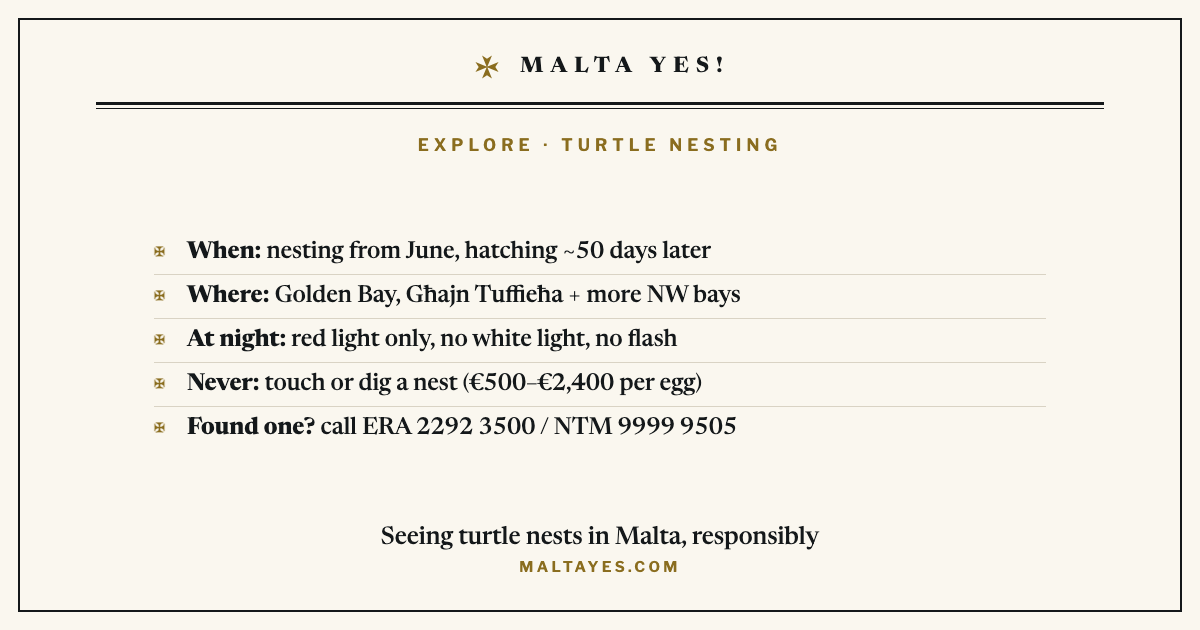
- When: nesting from around June; each nest hatches about 50 days after the eggs are laid, so hatchings run through the summer into September.
- Where (a track record): Golden Bay (Ramla tal-Mixquqa), Għajn Tuffieħa, Gnejna, Għadira on Malta, and Ramla l-Ħamra on Gozo. A 2020–2025 study counted 23 nests across six such beaches.
- What you’ll see: a fenced, signposted, taped-off patch of sand, patrolled around the clock by Nature Trust Malta volunteers through incubation. Not every nest produces a hatching you can watch.
- The golden rule at night: near a nest, red light only — no white light, no camera flash — and keep well back.
- It’s the law: disturbing a nest or eggs is a criminal offence, with a fine from about €500 up to €2,400 per egg, and the nesting site becomes a protected area.
- If you find one: call ERA on 2292 3500 or Nature Trust Malta on 9999 9505. Do not touch, dig or shine a light.
What you might be looking at
If you spot a roped-off square of beach with a small sign and tape running between posts, that is how a turtle nest is marked and protected in Malta. When a loggerhead comes ashore at night and lays her eggs, the Environment and Resources Authority (ERA) and Nature Trust Malta (NTM) fence the exact spot, sign it, and put it under a protection order. Volunteers then patrol it around the clock for the whole incubation period, and hatching events are watched with infrared cameras so the turtles are disturbed as little as possible. Malta increasingly guards its most fragile natural places this way — the same protective instinct behind the Blue Lagoon visitor cap on Comino.
This is genuinely new for Malta. Loggerheads are the most common turtle in local waters, but nesting on the beaches here has only been tracked systematically since 2020. A peer-reviewed study covering 2020 to 2025 logged 23 nests across six principal beaches — so a nest is a real event, not an everyday sight, and finding one is a small piece of luck.
When it happens
The season has a clear shape. Females come ashore to lay from around June, and each nest then takes close to 50 days to hatch — a figure confirmed on separate nests, all of which hatched at night, the tiny turtles finding the sea by moonlight. That puts the main hatching window from roughly August into September. Late July, when many people are on the beach anyway, sits right in the middle of the season: nests laid in June are maturing, and new ones can still appear.
One honest note on expectations: finding a marked nest does not guarantee you will see a hatching, and even a hatching is mostly hidden. Nests are not dug up to be watched, and success varies a great deal. One Għadira nest in 2025, examined afterwards, held 104 eggs, but only 22 hatched successfully — 69 were never fertilised and 13 stopped developing early. Seeing the roped-off nest is the realistic experience; a live hatchling dash to the sea is a rare bonus, usually managed quietly at night by the monitoring team.
Where the nests appear
Five beaches have a track record. On the Maltese mainland they are Golden Bay (Ramla tal-Mixquqa), Għajn Tuffieħa, Gnejna and Għadira — the sandy north-western bays — and on Gozo, Ramla l-Ħamra, the island’s famous red-sand beach. The 2020–2025 study added a sixth site, Rdum tal-Fajtata, for six principal beaches in all. The Golden Bay and Għajn Tuffieħa nests sit inside a Natura 2000 site protected under the EU Habitats Directive, which is part of why they are watched so closely.
Getting to them is straightforward. The north-western bays are reachable by bus or car — our guide on whether you need a car in Malta covers the trade-off — while Ramla l-Ħamra means a trip to Gozo, for which the car ferry versus fast ferry guide is the place to start. Ramla sits on the same wild, protected stretch of Gozo coast as the Dwejra salt pans, if you are making a day of it.
How to watch responsibly — and what never to do
The rules are simple, and they are the same ones the conservation teams follow. If you are near a nest, especially at night:
- Use red light only. No white torches, no phone torches, and above all no camera flash — artificial white light disorients hatchlings, which navigate by the natural glow over the sea.
- Keep your distance and keep it quiet. Do not sit on or lean over the fenced area; excessive noise, trampling and light near a nest all put the eggs and hatchlings at risk.
- Never touch, dig or move anything. Do not try to uncover eggs or “help” a hatchling to the water.
- Leave the tape and signs alone, and keep dogs well away.
This is not just etiquette. Malta protects the sites the same way it protects the turtles, and the visitor’s role is genuinely passive: look from a distance, and let the monitoring team do everything else. If you would like to do more than watch, Nature Trust Malta takes on volunteers to help with monitoring shifts through the season — a real option if you are staying a while.
If you spot a turtle or a nest yourself
If you see a turtle coming ashore, fresh tracks in the sand, or a nest that is not yet marked, report it straight away rather than approaching. The reporting lines are simple and worth saving before a beach day:
- ERA: 2292 3500
- Nature Trust Malta / Wildlife Rescue Team: 9999 9505
Tell them where you are and what you have seen, keep people and dogs back, and do not shine a light on the animal. An early report is exactly how many of Malta’s nests get protected in time.
This year’s nests
Exact nest locations shift from year to year and, deliberately, they are not always published in advance, to keep the nests safe. As of late July 2026, ERA’s public turtle page had not yet listed this season’s nests — its most recent entries were still from 2025 — even though the season is under way. That is normal rather than worrying: the safest place for up-to-date, location-specific information is ERA’s own channels and Nature Trust Malta’s social media, checked close to your visit. And if a beach you are on has an active nest, you will usually know the moment you see the fenced-off patch and the signs.
Frequently asked questions
Where can I see turtle nests in Malta?
The beaches with a nesting track record are Golden Bay (Ramla tal-Mixquqa), Għajn Tuffieħa, Gnejna and Għadira on Malta, plus Ramla l-Ħamra on Gozo. A nest is marked with a fence, a sign and tape, and patrolled by volunteers. Exact locations change each year and are not always announced in advance, so check ERA or Nature Trust Malta close to your visit rather than expecting a nest at any one beach.
When is turtle nesting season in Malta?
Loggerheads nest from around June, and each nest hatches roughly 50 days later, so hatchings run through the summer into September. Late July and August are the heart of the season. If you are on a north-western beach in these months, keep an eye out for a fenced, signposted patch of sand — that is a protected nest, and it means the season is in full swing where you are standing.
Can you watch baby turtles hatch in Malta?
Rarely, and never by digging a nest up. Hatchings happen at night, are managed quietly by the monitoring team, and even a healthy nest may produce far fewer hatchlings than eggs — one 2025 nest of 104 eggs produced just 22. The realistic experience is seeing a protected, roped-off nest during the day. If you do witness a hatching, stay back, stay quiet, and keep all white light and flash away.
What happens if you disturb a turtle nest in Malta?
It is a criminal offence. Under Malta's habitat-protection law, destroying or taking eggs carries a fine from about €500 up to €2,400 per egg, and the nesting site itself becomes a protected area. Beyond the law, disturbance — light, noise, digging, trampling — can kill a whole clutch. The rule is simple: keep your distance, use red light only at night, and report anything you are unsure about rather than approaching it. ---