
live
Who pays the letting agent's fee in Malta?
In Malta the tenant and landlord each pay about half a month's rent plus 18% VAT in letting agent fees. No law sets it, so the fee is negotiable.
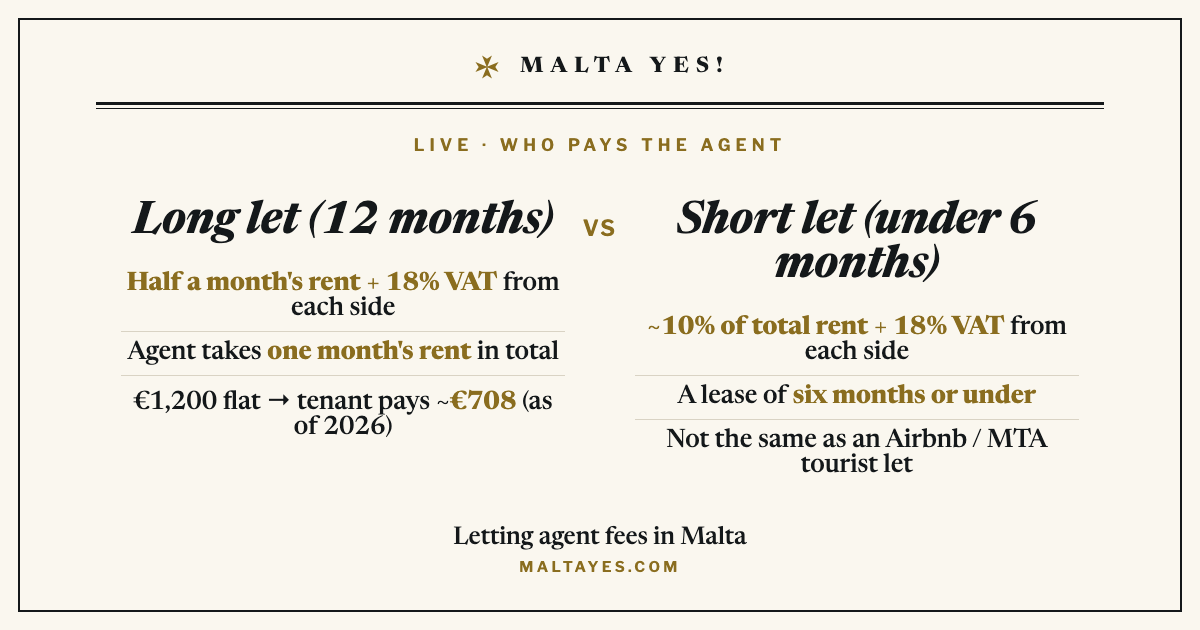
Short answer: on a normal long let, you and the landlord split it. The usual arrangement in Malta is that the tenant pays about half a month’s rent plus 18% VAT, and the landlord pays the same — so the agent collects one month’s rent in total, half from each side. It catches people out, because it is neither the “landlord pays everything” rule you find in some countries nor the “tenant pays the lot” rule you find in others. And here is the part worth knowing before you hand over any money: no law in Malta sets that fee or decides who pays it. It is custom. Custom can be negotiated.
The short version
- Long let (the 12-month standard): tenant pays about half a month’s rent + 18% VAT; the landlord pays the same
- Worked example: on a €1,200/month flat, the tenant’s share is roughly €600 + 18% VAT = €708
- Short let (under six months): a different rule — about 10% of the total rent + 18% VAT from each side
- Not set by law: Malta’s 2020 agent-licensing Act controls who may act as an agent, not the fee
- So it is negotiable: it is a market convention, not a fixed tariff — and a few agencies now advertise no tenant fee at all
The short answer, and why it surprises people
When you rent a long-term flat in Malta through an agency, the standard becomes simple once you know it. The agent’s commission is one month’s rent plus 18% VAT, and it is split down the middle: the landlord pays half, you pay half. In plain terms, your share as the tenant is about half a month’s rent, plus the VAT on that half.
People arriving from abroad often expect something different, which is why the question comes up again and again on expat forums. In Italy, for instance, the tenant typically pays the agency (the agenzia immobiliare) in full; in other countries the landlord carries the whole cost. Malta sits between those extremes: a shared fee, by convention. Nothing about it is a foreigner surcharge — a Maltese tenant renting the same flat pays on exactly the same basis.
What Malta’s 2020 licensing law does — and does not — regulate
It is worth being clear about the law, because the word “licensed” makes people assume the fee is fixed by the state. It is not. Malta’s Real Estate Agents, Property Brokers and Property Consultants Act (Act XXXII of 2020, with a compliance deadline at the end of 2021) was a genuine change: anyone acting as an estate agent in Malta now has to be licensed, with a register behind it. But the Act licenses people — it does not set a commission rate and it does not say who pays. So when an agent quotes you “half a month plus VAT”, they are quoting a market custom, not a legal tariff. That distinction is the whole reason the fee is open to discussion.
The standard split: half a month’s rent plus VAT
The reassuring thing is how consistently this figure shows up once you check the people who actually charge it. The consumer guide freemalta.com, citing the government’s own “Choosing a Property” guidance, describes the usual long-let practice as landlord and tenant each paying 50% of one month’s rent, plus VAT. Agencies’ own published rate cards say the same thing in their own words:
| Agency | What they publish for a long let |
|---|---|
| Malta Property | “Half of the first month’s rent plus 18% VAT, paid by the lessor and lessee” |
| Frank Salt | “A full month’s rent (plus 18% VAT)… half paid by the landlord, half by the tenant” |
| QuickLets | “Half of one month’s rent plus 18% VAT from the tenant, and the same from the landlord” |
So on a €1,200-a-month flat, QuickLets puts the tenant’s share at €600 plus 18% VAT, which is €708, payable on signing — and the landlord pays the matching €708. The total commission the agent earns is therefore one full month’s rent plus VAT, drawn evenly from both sides. Every one of those sources also stresses the same caveat: it is a convention, not a rule, and it is negotiable.
Short lets are different: the 10% rule
If you are renting for a short period rather than the usual year, the basis changes. For a short residential lease — the type Maltese law defines around a duration of six months or less — the agencies above charge not half a month’s rent but about 10% of the total rent, again plus 18% VAT, and again split between landlord and tenant. Malta Property and QuickLets both publish this figure. On a short stay the 10%-of-total basis can work out higher or lower than the half-month basis depending on how long you are renting for, so it is worth doing the sum before you sign rather than assuming the long-let figure applies.
“Short let” means two different things — don’t confuse them
This is where readers trip up. A “short let” in the sense above is still an ordinary residential tenancy, just a short one, and the 10% convention applies to it. It is not the same as a holiday let booked through a platform. A tourist or holiday rental — the Airbnb or Booking.com kind — is licensed separately by the Malta Tourism Authority, and that tourism-licensing regime does not set an estate-agent commission at all. If you book a two-week holiday flat online you are paying a platform and a host, not an estate agent’s split commission. Keep the two apart: the agency fee in this guide is about renting a home, long or short, through a letting agent.
What leverage you actually have
Because the fee is custom and not law, you have more room than you might think — especially in a market where supply is plentiful and agents compete hard for tenants.
A few practical points. First, ask early: before you fall for a flat, confirm in writing what the agency fee is, that it is “half a month plus 18% VAT”, and when it is due (normally on signing). Second, treat the fee as part of the deal, not a fixed add-on — in a slow month, or on a flat that has sat empty, an agent who wants the let done will sometimes trim their side. Third, watch the market: a small number of newer agencies now advertise themselves specifically on charging tenants no fee, so the “half a month” figure is no longer the only option in town. And before any of that, make sure the listing is genuine at all — fee haggling is pointless on a flat that does not exist, so it is worth knowing how to spot a fake long-let listing before you wire a deposit.
Two more things worth lining up while you are weighing the fee. Where you rent changes your whole budget, not just the commission: areas popular with newcomers, like St Paul’s Bay, tend to be cheaper than Sliema, and some people cut costs further by basing themselves in Gozo. And before you sign, check the flat for the things that cost money later — most famously that Maltese flats have no central heating, which matters more in winter than the agency fee ever will.
Frequently asked questions
Do tenants pay estate agent fees in Malta, or is it the landlord?
Both, usually. The long-standing convention on a long residential let is that the landlord and the tenant each pay the agent about half a month's rent plus 18% VAT. So you are not paying the whole commission, only your half — and because it is a custom rather than a legal requirement, it is open to negotiation.
How much commission do Malta letting agents typically charge?
On a long let, one month's rent plus 18% VAT in total, split equally, so your share is roughly half a month's rent plus the VAT on it. On a €1,200 flat that is about €708 for you and €708 for the landlord. Short lets of six months or under are charged differently — around 10% of the total rent plus VAT.
Can I avoid paying an agency fee when renting in Malta?
Sometimes. The fee is a market convention, not law, so it can be negotiated, particularly on a flat that has been empty or in a quiet month. You can also rent directly from a landlord with no agent involved, or use one of the newer agencies that advertise no tenant fee. Always confirm the fee in writing before you commit.
Is there an agency fee for an Airbnb or short-let holiday booking?
No — that is a different arrangement. Holiday and tourist rentals are licensed by the Malta Tourism Authority and booked through a platform or host, with no estate-agent split commission. The agency fee in this guide applies to renting a home through a letting agent, whether on a long lease or a short residential one.